
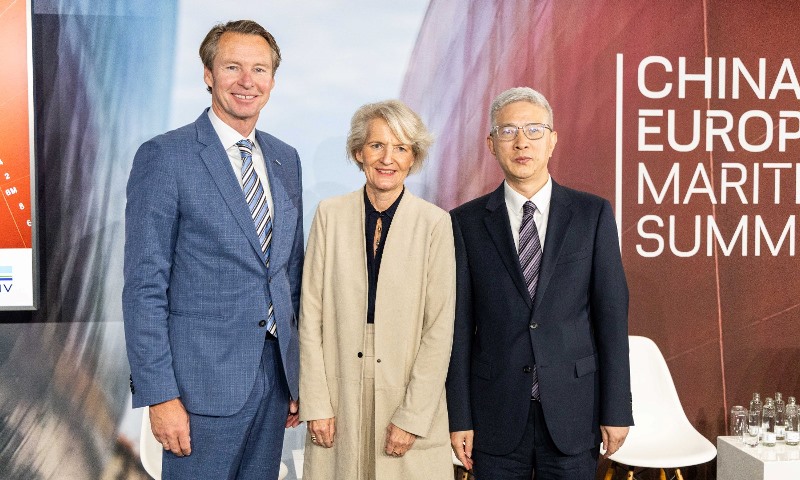
Chinese shipbuilders and European shipowners have called for closer collaboration in vessel development, alternative fuels and digitalisation as the maritime industry navigates decarbonisation, evolving regulations and uncertainty over future fuel pathways.
The call came at the inaugural China-Europe Maritime Summit, held during SMM 2026, and jointly organised by the China Association of the National Shipbuilding Industry (CANSI), the German Shipowners’ Association (VDR) and DNV.
The summit brought together senior leaders from China’s shipbuilding sector and Europe’s shipping community to discuss the future of commercial vessel development. Energy efficiency, operational flexibility and digital innovation emerged as key priorities for the industry.
“Gathering leaders from across Chinese shipbuilding, European shipping and the wider maritime value chain in one room is both timely and important,” said Knut Ørbeck-Nilssen, Group President and CEO, DNV. He added that decisions being taken today would shape shipping for decades and stressed the importance of working together to address the industry’s future challenges.
Xu Peng, Chairman of China State Shipbuilding Corporation (CSSC), said China and Europe possess complementary strengths and share common objectives in the maritime sector. He described the summit as a starting point for deeper cooperation between Chinese shipbuilders and European shipping companies, with the potential to expand collaboration across the entire maritime value chain.
Dr. Gaby Bornheim, President of the German Shipowners’ Association (VDR), emphasised the long-term nature of ship investments and the importance of trusted partnerships between shipowners and shipbuilders.
“A new vessel is never an investment for the next quarter. It is a commitment for decades,” she said, noting that many advanced commercial vessels have resulted from cooperation between European shipowners and Chinese shipbuilders.
China’s shipbuilding industry currently accounts for around 70% of the global shipbuilding orderbook, while European shipowners operate more than one-third of the world’s fleet capacity, highlighting the strategic importance of cooperation between the two maritime powerhouses.
The summit featured two high-level panel discussions moderated by Dr. Martin Kröger, CEO of VDR, and Li Yanqing, Vice Chairman and Secretary General of CANSI.
Participants included senior executives from leading Chinese shipbuilders such as China Merchants Industry (CMI), Guangzhou Shipyard International (GSI), Shanghai Waigaoqiao Shipbuilding (SWS) and Shanghai Merchant Ship Design & Research Institute (SDARI).
European shipping and maritime companies represented included Vogemann Reederei, Briese Schiffahrt, Bernhard Schulte, MPC Containerships and Grieg Edge, alongside DNV.
The discussions underscored the need for stronger China-Europe partnerships to develop vessels that can adapt to changing fuel technologies, regulatory requirements and operational conditions. The participants also highlighted digitalisation and innovation as critical enablers of a more efficient and sustainable global shipping industry.
The summit concluded with a shared recognition that closer cooperation across shipbuilding, shipping and the wider maritime value chain will be essential to support the industry’s transition towards a more flexible, efficient and lower-emission future.