
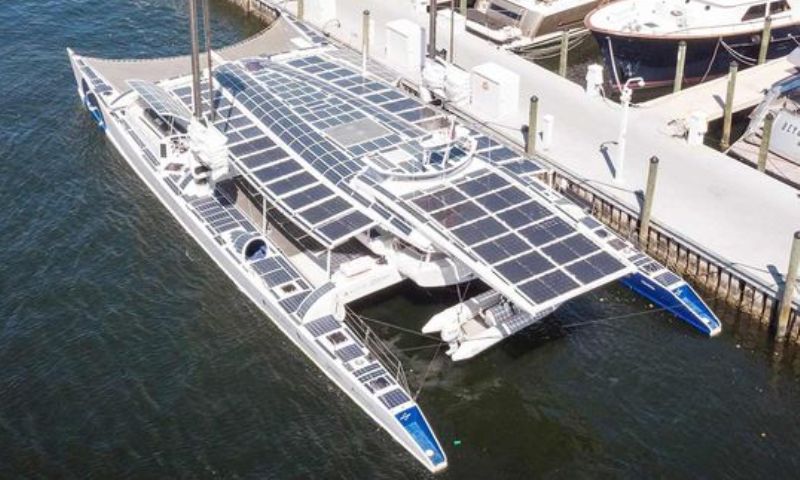
A ship powered by renewable energy, including hydrogen produced onboard, is docked in the southeastern US state of Florida this week as it prepares to finish the last leg of a voyage around the world.
The 100-foot catamaran, dubbed the Energy Observer, has logged 63,040 nautical miles without using fossil fuels since it first started sailing in 2017. This particular trip around the world started in 2020.
The mission has tested renewable energy — including by using solar panels and advanced sails called “oceanwings” — as a power source in multiple climates off the coasts of Africa, Asia and Antarctica.
The automated 12-meter wings boost the ship’s speed and reduce energy consumption.
“We learned a lot along this journey,” captain Marin Jarry told AFP in Fort Lauderdale, just north of Miami.
Jarry said he wants to share what he has learned through seminars, articles and videos.
The project hopes to influence the shipping and maritime sectors, especially as its “oceanwings” have already been used in commercial shipping.
They were used on a freighter called the Canopee, which was designed to transport parts of the Ariane 6 rocket from Europe to a launch center in French Guiana on the northeast tip of South America.
In the course of the Energy Observer’s current voyage, 40 percent of the vessel’s energy has come from wind, 40 percent from solar and 20 percent from hydrogen.
The ship is set to make stops in Washington, New York and Boston before heading back to France.
An Energy Observer 2 is already in the works: a cargo ship measuring nearly 400 feet (120 meters) long, with a capacity to carry 5,000 metric tons. It is set to run on liquid hydrogen.
Maritime transport generates around 3 percent of worldwide greenhouse gasses.