
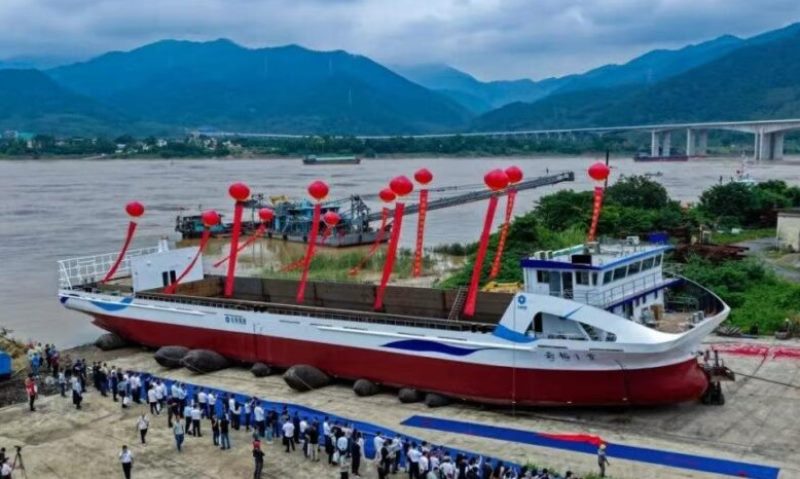
China has launched its largest hydrogen-powered inland cargo vessel, marking another significant step in the country’s efforts to decarbonise inland waterway transport. The 2,000-tonne Yun Tao No. 1 was launched at Zhaoqing in Guangdong province and is expected to operate on the Beijiang River network.
Developed by Guangdong Yuntao Hydrogen Energy Technology in collaboration with China State Shipbuilding Corporation (CSSC), the 69.3-metre vessel can carry up to 2,000 tonnes of cargo, including approximately 140 containers or bulk commodities such as ore, grain and coal.
The vessel is powered by three domestically developed 260 kW hydrogen fuel-cell generator sets supported by lithium battery systems. Equipped with an intelligent energy management system, Yun Tao No. 1 has a reported operating range of 760 km, with power efficiently distributed between the fuel cells and batteries.
According to the developer, the hydrogen-powered vessel is expected to reduce fuel costs by 25-30% compared with a conventional diesel-powered ship, although actual savings will depend on hydrogen prices, refuelling infrastructure and operational performance.
Guangdong Yuntao Hydrogen Energy Technology plans to deploy a fleet of 100 standardised hydrogen-powered inland vessels across the Pearl River basin over the next four years, supported by dedicated hydrogen bunkering infrastructure. The company aims to achieve subsidy-free commercial operations by 2028.
China is rapidly expanding its hydrogen-powered inland shipping programme. Earlier this year, the 64-TEU Dong Fang Qing Gang entered commercial service between Jiaxing and Hangzhou, while another 2,000-tonne hydrogen internal-combustion and electric-powered vessel is scheduled to be launched in Wuhan in 2028.
The latest launch highlights China’s growing investment in hydrogen-based maritime technologies and the development of supporting fuel production, storage and refuelling networks, as the country moves from pilot projects towards large-scale commercial zero-emission inland shipping.