
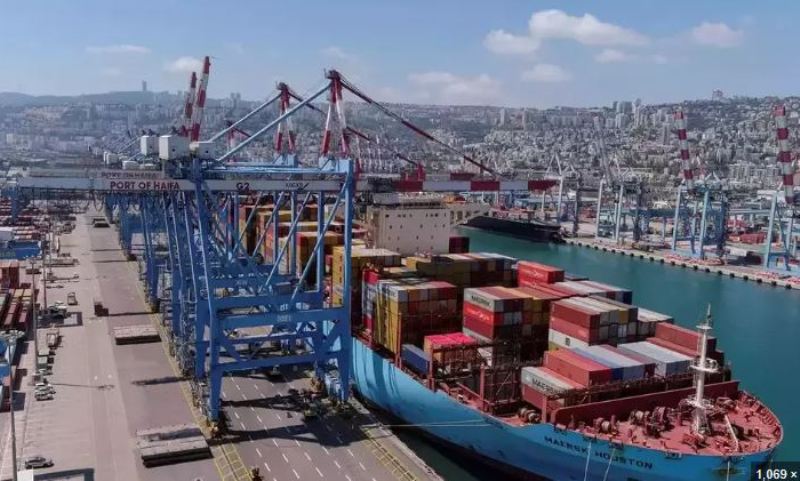
Haifa Port is positioning itself to play a central role in the proposed India–Middle East–Europe Economic Corridor (IMEC), which aims to create a multimodal trade route linking India with the Gulf, the Middle East and Europe. The proposed corridor would combine maritime, rail and port infrastructure to provide an alternative connection between Asian and European markets.
Under the current IMEC concept, cargo would move by sea from India to the Gulf and then travel overland through the UAE, Saudi Arabia and Jordan before reaching Israel. Haifa Port would serve as the Mediterranean gateway, with goods continuing by sea to European destinations.
Haifa Mayor Yona Yahav has described the corridor as an opportunity to transform the city’s strategic importance, saying Haifa could become a major transit point once IMEC is implemented. The port already has established container-handling infrastructure and connections to Israel’s rail network, giving it a potential advantage as the European-facing gateway of the corridor.
India also has a direct commercial interest in Haifa Port. Adani Ports and Gadot Group acquired the port in 2023, strengthening India’s presence in Israel’s maritime infrastructure and creating a potential platform for deeper India-Europe trade connectivity.
However, significant challenges remain before Haifa can handle large-scale IMEC traffic. A recent Middle East Institute assessment identified port capacity and rail connectivity as important constraints. Haifa’s container capacity is estimated at around 1.5 million TEU annually, while the proposed corridor would require efficient rail links across Jordan and Saudi Arabia to connect the Gulf with Israel.
The project’s geopolitical environment has also become more complicated. Recent regional conflicts and disruptions around the Strait of Hormuz and Red Sea have increased interest in alternative trade corridors, but they have also raised questions over the security and viability of the original IMEC route. Some proposals are now examining alternative alignments through the region.
For India, a functioning IMEC could provide an additional multimodal route to European markets and reduce dependence on traditional maritime chokepoints. For Haifa, the corridor offers the prospect of becoming a major India–Middle East–Europe logistics gateway, provided the required rail infrastructure, political agreements and security conditions are established.