
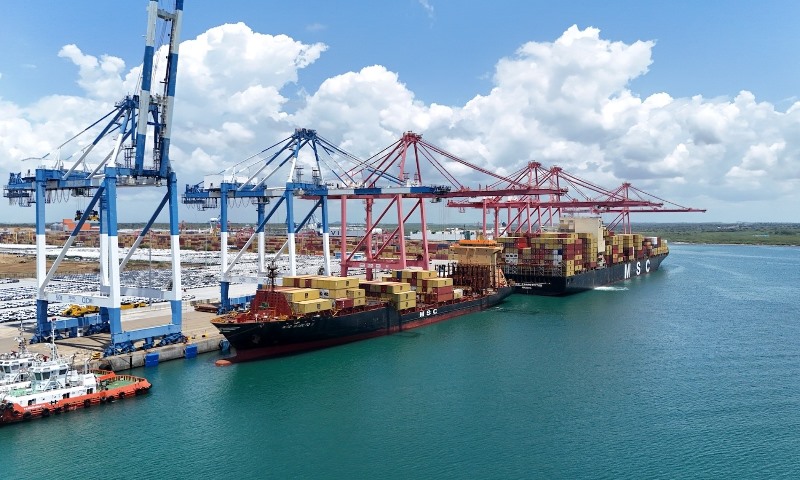
Hambantota International Port Group (HIPG) is anticipating fresh growth opportunities from a sustained return of container shipping to the Red Sea and Suez Canal route, as it prepares to increase annual container handling capacity to 2 million TEUs in the first quarter of 2027.
The outlook follows maritime consultancy Linerlytica’s October 2026 forecast of a full-scale return of container shipping to the Suez route by Q1 2027. Although some services are already returning, the pace of recovery will depend on security conditions and individual shipping lines’ operational decisions.
Bindu Ranasinghe, General Manager – Commercial and Marketing at HIPG, said the Red Sea disruption had accelerated the port’s entry into container transhipment. Congestion at Colombo Port created demand for additional capacity, prompting Hambantota to begin handling overflow cargo in April 2024 before moving towards a full-scale container operation.
HIPG commenced its inaugural MSC container transhipment service on April 9, 2024, and has since committed US$149 million to new container handling equipment as part of its expansion programme.
Located approximately 10 nautical miles from the main East–West shipping route, Hambantota offers a strategic geographical advantage for vessels transiting the Suez Canal. A sustained return to the established route could strengthen the port’s competitiveness as shipping lines reconsider diversions around the Cape of Good Hope.
The recovery could also generate opportunities beyond container handling. With an estimated 75% of East–West tonnage currently routing around Africa, a shift back towards the Suez corridor could increase demand for bunkering, ship supplies and other marine services at Hambantota.
HIPG is also working to develop gateway container cargo, enabling Sri Lankan businesses to use the port for imports and exports alongside its existing transhipment operations. Industrial development within the port, surrounding Board of Investment zones and proposed expansion projects are expected to support this effort.
A planned container inspection centre is expected to facilitate gateway operations, with benefits anticipated from the first quarter of 2027. HIPG believes the combination of industrial activity, inspection infrastructure and expanded container handling capabilities will help attract additional shipping lines and cargo volumes.
Meanwhile, developments around the Strait of Hormuz present a separate set of opportunities and uncertainties. Disruptions affecting access to Gulf ports have encouraged alternative cargo arrangements, with Hambantota handling transhipment cargo for onward feeder connections to accessible regional ports.
HIPG noted that even if access to Gulf ports improves, the return of cargo to previous routes will depend on commercial commitments, established service networks, insurance conditions and security assessments. Alternative connections developed during the disruption could continue where they offer commercial value to customers.
HIPG’s strategy is to convert the capabilities developed during periods of maritime disruption into long-term customer relationships. By integrating container transhipment, gateway cargo, industrial development, bunkering, ship supplies and other marine services, Hambantota aims to strengthen its position as a regional maritime and logistics hub as shipping patterns begin to normalise.