
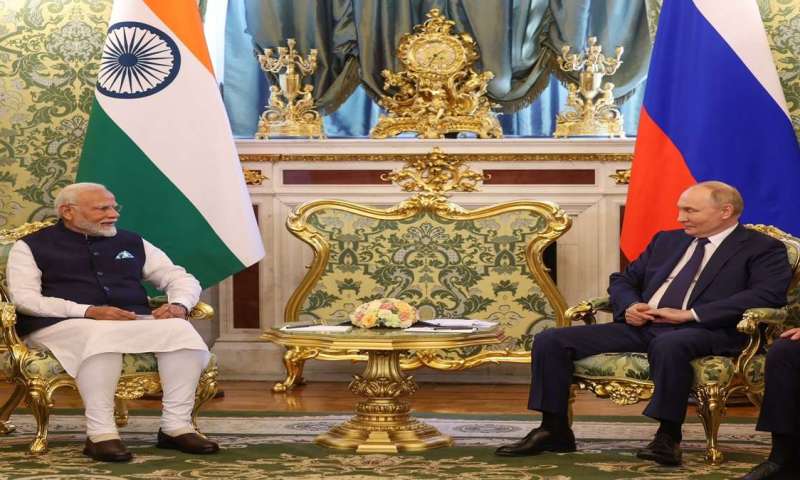
Following the 22nd India-Russia Annual Bilateral Summit held on July 8-9 in Moscow, both sides agreed on nine key economic cooperation areas, including eliminating non-tariff trade barriers, developing a bilateral settlement system using national currencies, cooperation in key energy sectors and facilitating entry of Indian and Russian companies in each other’s markets by creating subsidiaries and industrial clusters.
Russian President Vladimir Putin and Indian Prime Minister Narendra Modi discussed current issues of bilateral cooperation and the development of the Russia-India Special and Privileged Strategic Partnership. Both sides aim at raising bilateral trade volume to over $100 billion by 2030.
Both sides will continue their dialogue on liberalising bilateral trade, including the possibility of setting up an Eurasia Economic Union (EAEU)-India Free Trade Area, a release from the Indian Prime Minister’s Office said.
Both the countries want to consistently introduce digital financial instruments into mutual settlements.
Russia plans to raise cargo turnover with India by launching new routes of the North-South International Transport Corridor, the Northern Sea Route and the Chennai-Vladivostok Sea Line.
Both sides want to optimise customs procedures through intelligent digital systems for barrier-free movement of goods.
They will bolster interaction in infrastructure development, transport engineering, automobile production and shipbuilding, space and other industrial sectors.