
India’s domestic automobile industry is expected to sustain its growth momentum in the second half of FY27, although sales growth may moderate due to a higher base, according to Shenu Agarwal, President of the Society of Indian Automobile Manufacturers (SIAM).
Automobile sales across vehicle categories surged 20% year-on-year during the first half of the financial year ended September 30, reflecting strong demand across passenger vehicles, two-wheelers, three-wheelers and commercial vehicles.
Speaking in his first interview since taking charge as SIAM President in September, Agarwal told The Economic Times that improved affordability following the GST 2.0 reforms, strong financing support, resilient rural and urban demand, and festive-season purchases are expected to support industry growth during the remainder of the financial year.
He also identified new vehicle launches, infrastructure investments, healthy freight movement and fleet replacement as important demand drivers. Agarwal is also the Managing Director of commercial vehicle manufacturer Ashok Leyland.
EVs and Alternative Fuels Gain Momentum
The growing adoption of electric vehicles (EVs) and alternative-fuel technologies is emerging as another significant driver of the automotive market. Passenger vehicle sales increased 31% during the July-September quarter, supported partly by demand for electric and alternative-fuel vehicles.
According to Agarwal, India’s EV ecosystem is steadily maturing, with a wider range of vehicle offerings, an expanding charging network and supportive government policies encouraging adoption.
He expects demand for cleaner and more fuel-efficient vehicles to continue rising over the medium term, playing an important role in India’s transition towards sustainable mobility. The recently notified Corporate Average Fuel Efficiency (CAFE) III norms are also expected to encourage investments in advanced and sustainable automotive technologies.
However, the industry continues to face potential headwinds, including inflationary pressures, higher interest rates and rising input costs. Despite these challenges, Agarwal said the industry remains cautiously optimistic and expects growth to remain positive.
Automotive Exports Record Strong Growth
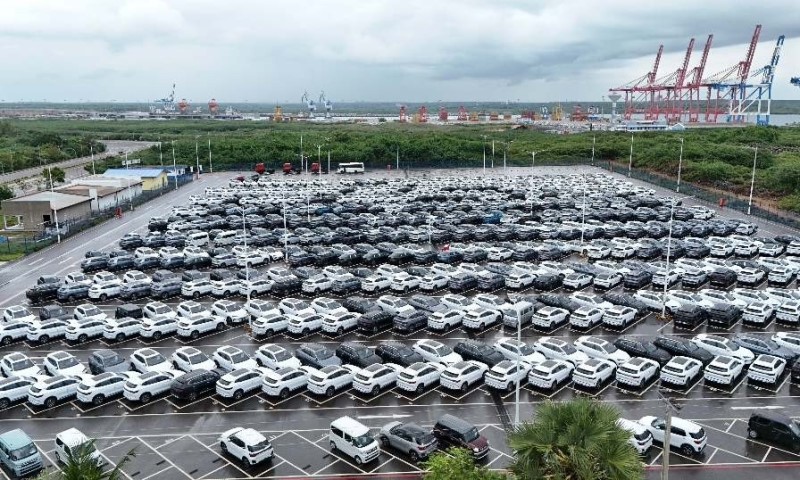
India’s automotive exports remained largely resilient during the July-September quarter despite geopolitical uncertainties and disruptions in international trade and logistics.
Two-wheeler exports increased 28% year-on-year to 1.65 million units, marking the highest-ever exports for a second quarter. Three-wheeler exports grew 30%, while commercial vehicle exports recorded a significant 72.5% increase.
Passenger vehicle exports, however, declined 5.2% to 229,000 units during the quarter, affected by a high comparative base and logistics constraints arising from the West Asia crisis.
Agarwal said the broad-based export growth across most vehicle categories demonstrates the strength and resilience of Indian automotive products in overseas markets. The industry will continue to closely monitor geopolitical developments and their potential impact on international trade and supply chains.
Entry-Level Vehicle Segment Shows Strong Recovery
The entry-level automobile segment is also witnessing a notable revival, following the reduction in Goods and Services Tax (GST) rates from September 2025, which improved affordability and prompted manufacturers to reduce vehicle prices.
During the first half of FY27, sales of entry-level passenger cars measuring up to 3.6 metres surged 86%.
The recovery extended to mass-market two-wheelers, with entry-level scooters of up to 125 cc recording 17.5% growth. Moped sales in the 75-100 cc category increased 22%, while 110 cc motorcycle sales grew 5.1%.
The improvement points to a revival in demand among first-time buyers and price-sensitive consumers, supported by better affordability and favourable market conditions.
Infrastructure Investment to Support Long-Term Expansion
Agarwal said India’s relatively low vehicle penetration offers considerable headroom for the automotive industry to expand over the coming years.
Sustained economic growth, continued infrastructure investment, supportive policies for cleaner mobility, expansion of EV charging and alternative-fuel networks, and improved access to vehicle financing will remain critical to strengthening the sector.
With domestic consumption recovering across key vehicle segments and exports maintaining broad-based growth, the Indian automobile industry is expected to retain its positive trajectory, even as manufacturers navigate global uncertainties, cost pressures and a high-base effect in the second half of FY27.