
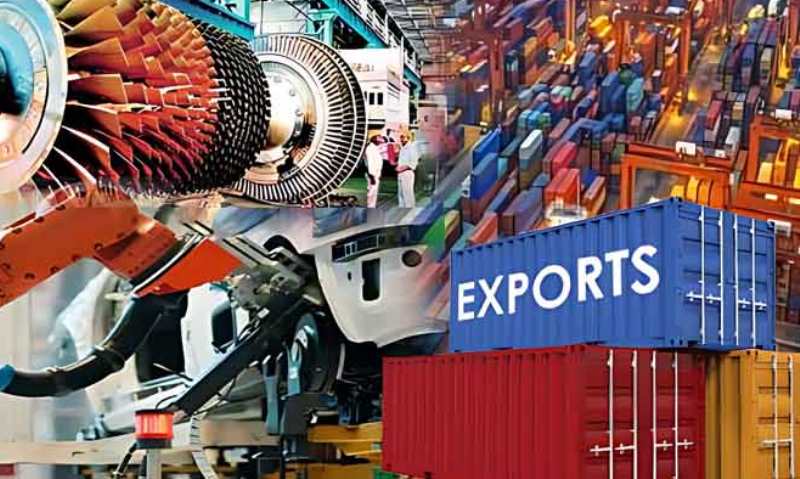
India’s merchandise export profile is undergoing a major transformation, with high-tech and value-added sectors such as electronics, engineering, pharmaceuticals, and agriculture emerging as dominant contributors in the financial year 2024-25.
Together, these four sectors accounted for over 50 per cent of the country’s total exports, according to newly released government data, marking a strategic shift in India’s export basket from traditional to innovation-driven segments, according to news agency PTI.
This structural shift reflects the success of ongoing policy efforts such as the Production-Linked Incentive (PLI) schemes and “Make in India” initiatives aimed at boosting domestic manufacturing and technology-intensive exports.
Engineering goods retained their top spot, accounting for 26.67 per cent of India’s total exports, valued at $437.42 billion.
Shipments in this category rose 6.74 per cent year-on-year to $116.67 billion, with key markets including the US, UAE, Saudi Arabia, UK, and Germany. Engineering exports have consistently remained above $100 billion since FY22.
Electronics exports surged by an impressive 32.46 per cent — the highest growth among all sectors — reaching $38.58 billion, up from $29.12 billion in FY24.
Exports have more than doubled since FY22. Within this, computer hardware and peripherals led the momentum, doubling in value from $0.7 billion to $1.4 billion, with major demand coming from the UAE, US, Netherlands, UK, and Italy.
“The electronics sector is clearly a rising star in India’s export landscape, showing the tangible impact of targeted policy incentives,” a senior government official said.
Pharmaceutical exports grew 9.4 per cent to $30.47 billion, reaching over 200 countries. This reflects India’s continued leadership in supplying affordable, high-quality medicines to global markets, a trend reinforced since the pandemic.
Agriculture and allied products also showed robust growth, with exports rising 7.36 per cent to $51.86 billion. India’s agricultural strength lies in its diversified product base and global leadership in key commodities like rice, spices, coffee, and marine products.
Rice exports hit a record high of $12.5 billion, cementing India’s position as the world’s top rice exporter with a 40 per cent global market share. Coffee exports rose to $1.81 billion, with Karnataka and Kerala maintaining leadership in production and several varieties enjoying GI tag recognition.
The rise in marine exports to $7.2 billion, along with increased fruit and vegetable shipments to $3.9 billion, reflects growing diversification in agri-based trade.
Tobacco and tea also performed well, with tobacco exports climbing to $1.98 billion and tea exports increasing to $0.92 billion.
India is now the second-largest tobacco producer and seventh-largest coffee exporter globally.
With growing global appetite for Indian products across value-added sectors and the success of targeted government schemes, India’s export outlook appears poised for continued diversification and scale.
This year’s data not only reflects a resilient export economy but also signals a strategic pivot toward more technology-intensive, globally competitive industries — an essential foundation for India’s ambition to become a $5 trillion economy.