
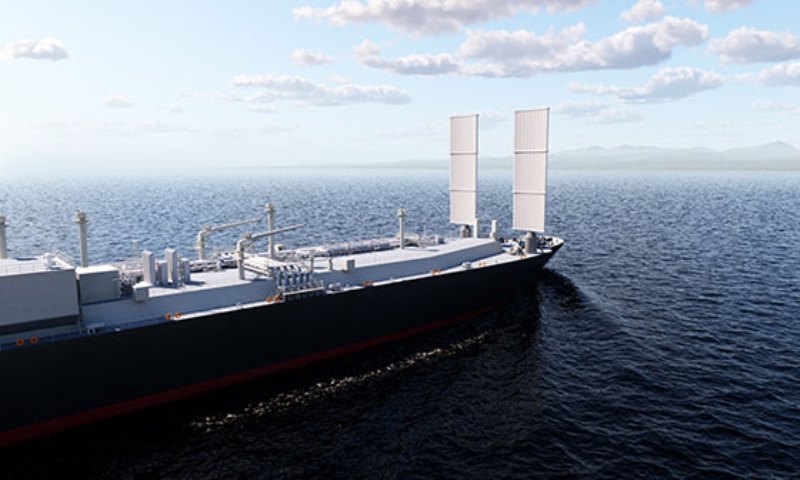
Mitsui O.S.K. Lines, Ltd. (MOL) announced that an LNG carrier under construction for long term charter to and Chevron Shipping will be delivered with MOL’s Wind Challenger hard sail wind-assisted propulsion system installed.
The companies said the vessel will be the first LNG carrier with a wind assisted propulsion system. Installation of Wind Challenger on an LNG carrier was granted approval in principle by ClassNK in August this year.
The LNG vessel due to receive the first installation is under construction at Hanwha Ocean’s Geoje Shipyard with a delivery date in 2026.
The sails have been positioned to minimise the impact on the existing designs of membrane type LNG Carriers, said MOL, enabling existing mooring arrangements to remain in place unchanged.
“We’re proud to partner with MOL in Wind Challenger’s industry-first LNG installation,” said Barbara Pickering, president of Chevron Shipping Company. “This is another example of using novel approaches in hard-to-abate sectors to reduce carbon intensity in our LNG fleet.”
Takeshi Hashimoto, president and CEO of MOL, said, “With the understanding and co-operation of Chevron, we are delighted to be able to extend the Wind Challenger Project to LNG carriers in addition to the two delivered Wind Challenger-equipped bulkers.”
MOL has set a target to have 25 vessels equipped with Wind Challenger by 2030, and 80 by 2035. Earlier this year, it announced installations for six bulk carriers, with expected fuel and emissions savings of 7-16% per vessel.
“Achieving GHG reduction in the maritime transport of LNG, which is increasingly in demand worldwide as a transition fuel, is a very important mission for us,” said Hashimoto. “This project will undoubtedly be a significant milestone towards achieving ‘net zero GHG emissions by 2050’, a medium to long-term goal of the Mitsui O.S.K. Lines Group, as stated in our “Environmental Vision 2.2″.”