
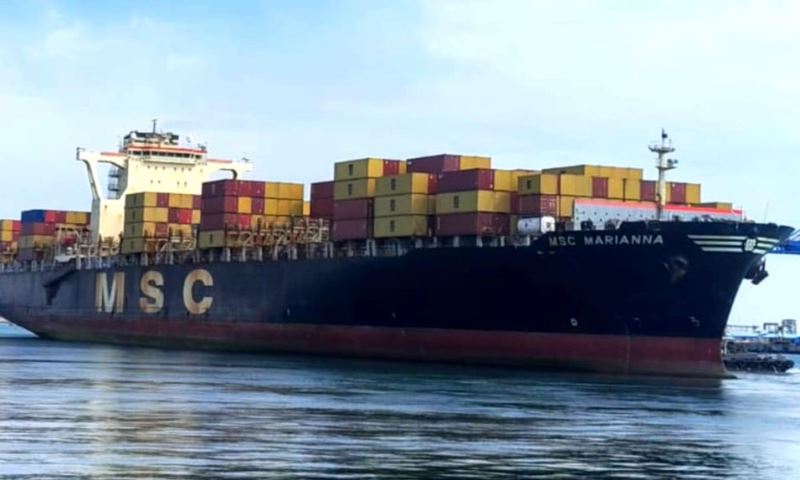
Mediterranean Shipping Company (MSC) has announced plans to partially restore transits through the Suez Canal on a limited number of its East-West services, signalling growing confidence among major container carriers in the security situation in the Red Sea.
In a customer advisory issued on 24 August, MSC said the decision followed a “comprehensive review” of the latest security and operational conditions in the Red Sea region. The transition will be implemented on a service-by-service basis, covering both westbound and eastbound voyages.
MSC said it will continue to closely monitor developments in the region in coordination with relevant authorities and security partners. The company stressed that the safety of its seafarers, vessels and customers’ cargo remains its overriding priority.
Contingency arrangements will remain in place, allowing individual voyages to be adjusted if security or operational conditions change.
The move comes as other major carriers also begin cautiously testing a return to the Suez route after months of avoiding the Red Sea and routing vessels around the Cape of Good Hope.
Drewry senior manager for container research Simon Heaney said MSC’s decision indicates that major carriers are becoming increasingly confident about the safety of the route, although he warned that a single incident involving a container ship could quickly undermine that confidence.
Meanwhile, Maersk and Hapag-Lloyd, partners in the Gemini Cooperation, announced earlier this month that their AE19 service would return to the trans-Suez route instead of continuing via the Cape of Good Hope.
Maersk CEO Vincent Clerc said during the company’s Q2 earnings presentation that four services had already been reintroduced through the Bab el-Mandeb Strait, representing around one-third of the volumes that would normally transit the strait and the Suez Canal.
According to Linerlytica, Maersk increased its trans-Suez activity last week, recording 11 Bab el-Mandeb transits in each direction, compared with 15 by CMA CGM. However, Hapag-Lloyd has remained more cautious, with no vessels passing through the Red Sea during the previous three weeks.
Most other major Asian carriers continue to avoid the route.
The gradual return of MSC and other carriers could mark an important shift for global container shipping. A broader reopening of the Suez Canal route would significantly reduce sailing distances and fuel consumption compared with Cape of Good Hope diversions, while also restoring faster connectivity between Asia, Europe and other major trade lanes.
However, carriers are expected to maintain a cautious, closely monitored approach, with the pace of the return ultimately dependent on the security situation in the Red Sea and Bab el-Mandeb region.