
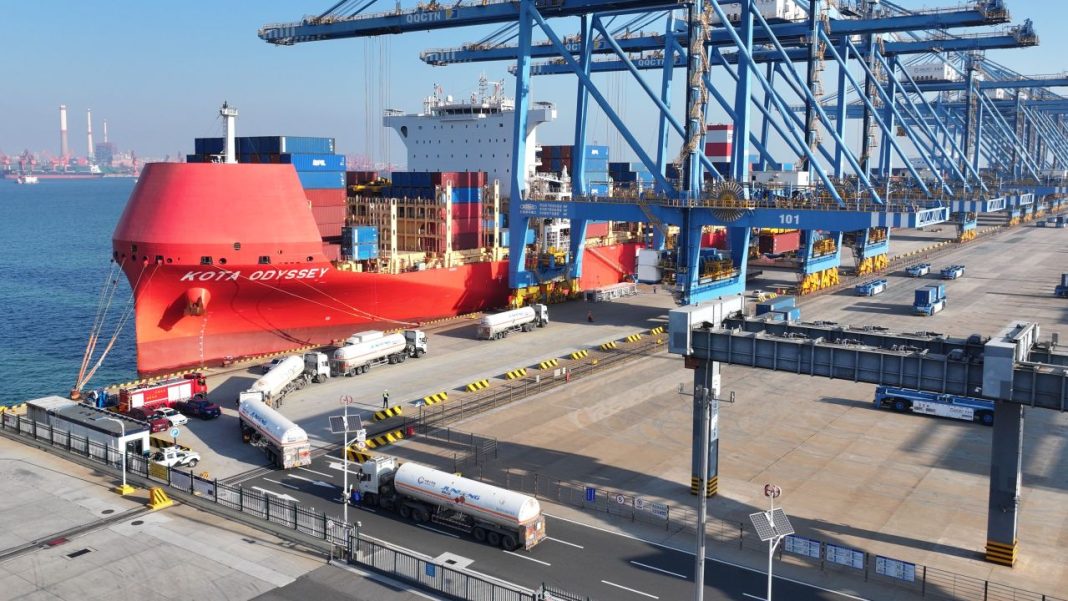
Pacific International Lines (PIL) and Qingdao Port Group have achieved a significant milestone in maritime decarbonisation by completing China’s first Liquefied Bio-Methane (LBM), also known as Bio-LNG, bunkering operation for international shipping.
The landmark operation involved PIL’s LNG dual-fuel container vessel Kota Odyssey, which received Bio-LNG at Qingdao Port, marking the first time PIL has used the renewable marine fuel in its fleet.
Produced from organic feedstocks, Liquefied Bio-Methane offers the potential for significant lifecycle carbon emissions reductions compared with conventional marine fuels. An important advantage is that it can be used as a drop-in fuel in existing LNG dual-fuel vessels without requiring modifications to their engines or fuel systems.
The successful operation demonstrates the growing potential of renewable marine fuels and highlights the importance of collaboration among shipping companies, port authorities and fuel suppliers in establishing the infrastructure and supply chains required to accelerate maritime decarbonisation.
For PIL, the development represents another step in its long-term strategy to reduce the environmental footprint of its fleet while preparing for the wider adoption of alternative fuels.
Since 2022, PIL has placed orders for 28 newbuild LNG dual-fuel vessels, strengthening its capacity to adopt lower-carbon fuels as they become increasingly available. The company aims to build greater fuel flexibility into its fleet and progressively integrate renewable alternatives into its operations.
The successful Bio-LNG bunkering at Qingdao also highlights China’s emerging role in facilitating the adoption of alternative marine fuels for international shipping, as the global maritime industry continues its transition towards a lower-carbon future.