
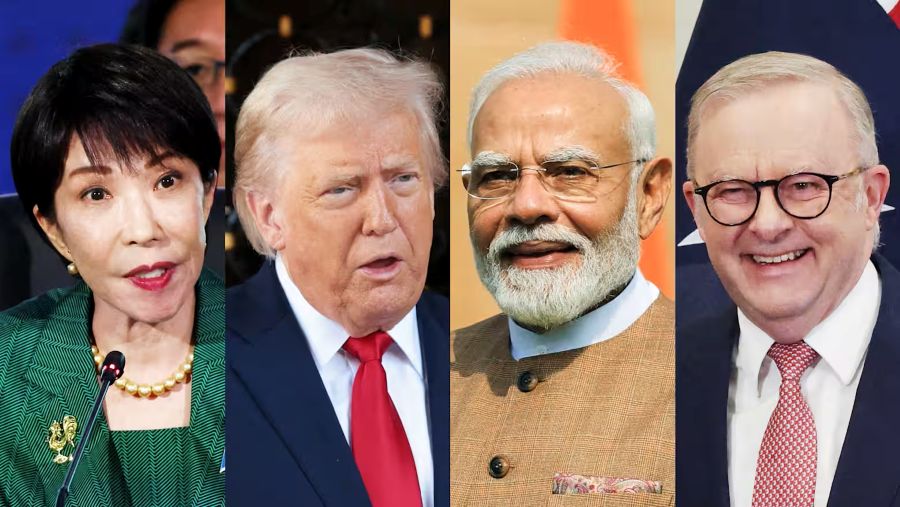
Leaders of the Quadrilateral Security Dialogue (Quad), comprising India, the United States, Japan and Australia, have expressed serious concerns over economic coercion and arbitrary export restrictions, calling for stronger cooperation to safeguard global supply chains and maintain stability in the Indo-Pacific region.
The concerns were highlighted in a joint statement following the Quad Leaders’ Summit held in Manila on November 17, 2026, attended by US President Donald Trump, Indian Prime Minister Narendra Modi, Australian Prime Minister Anthony Albanese and Japanese Prime Minister Sanae Takaichi.
The leaders strongly opposed destabilising or unilateral actions aimed at changing the status quo through force or coercion, noting that such measures could escalate tensions and undermine regional peace and stability.
While the statement did not name any country, the concerns come amid growing trade tensions surrounding restrictions on critical mineral exports, particularly rare earth elements essential for manufacturing electric vehicles, electronics and other advanced industrial products.
The Quad leaders also underscored the importance of securing critical supply chains and strengthening economic resilience. For the maritime and logistics sector, reliable access to essential raw materials, predictable trade policies and uninterrupted cargo movements remain vital to maintaining international trade flows.
Reaffirming their commitment to a free and open Indo-Pacific, the four countries also pledged to work together to ensure open, safe and resilient maritime transit corridors across the region.
The summit further announced the Indo-Pacific Maritime Surveillance Collaboration to enhance information sharing and maritime domain awareness. The partners also outlined plans for joint maritime exercises in 2027 involving P-8 and P-3C patrol aircraft.
In another significant development, the leaders announced the inaugural Quad Business Leaders’ Forum, scheduled for early 2027, to promote commercial partnerships, business engagement and investment opportunities among the four countries.
The latest commitments underline the growing importance of economic security, resilient supply chains and maritime connectivity in shaping the future of international trade and the Indo-Pacific economy.