
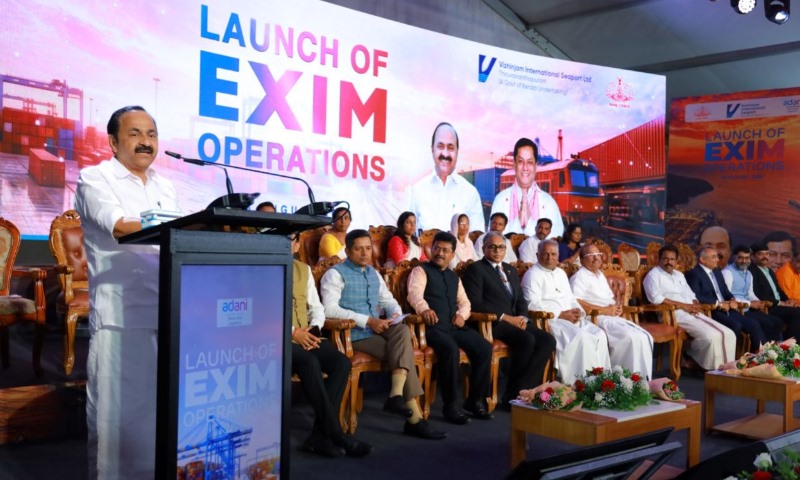
Vizhinjam International Seaport has entered a new phase in its development with the formal commencement of gateway Export-Import (EXIM) operations, marking its transition from an international transshipment hub into a full-fledged gateway for India’s global trade.
Kerala Chief Minister V. D. Satheesan officially flagged off the first export containers at Vizhinjam on Tuesday, marking a significant milestone for Kerala’s maritime sector and India’s logistics network. Reports said two containers were flagged off during the launch ceremony.
The commencement of EXIM operations means Vizhinjam can now handle cargo being directly exported from and imported into India, in addition to its existing transshipment activities. The development is expected to provide exporters and importers in Kerala and neighbouring regions with a new international gateway, reducing dependence on overseas transshipment hubs such as Colombo, Singapore and Dubai for cargo moving to western markets.
From Transshipment Hub to Global Cargo Gateway
Vizhinjam began commercial operations as a transshipment facility in 2024, with its strategic location close to major international shipping routes giving it a strong advantage in handling large container vessels.
The launch of gateway EXIM operations represents the next major step in the port’s evolution. Until now, the port’s principal role was ship-to-ship transshipment, with containers transferred between international services. With the new gateway function, exporters can route cargo directly through Vizhinjam, while importers can receive eligible cargo through the port.
The port was granted final Customs approval in July to commence EXIM cargo operations from August 18. The approval formally paved the way for Vizhinjam to function as a Customs port for international export and import cargo.
The new gateway capability is expected to improve cargo connectivity, shorten transit chains and potentially reduce logistics costs for businesses in Kerala and the wider southern Indian hinterland. Exporters who previously routed consignments through Colombo, Singapore or Dubai will have the option of using Vizhinjam for direct international movement.
Customs Framework Enables Initial EXIM Operations
The initial EXIM framework has been structured around specific Customs conditions.
Import operations will initially focus on Full Container Load (FCL) cargo eligible for Direct Port Delivery, while export operations will primarily cover factory-stuffed, self-sealed or Customs-sealed FCL containers. In the absence of a designated Container Freight Station at the port, Less-than-Container Load cargo, loose cargo and containers requiring de-stuffing or CFS examination are subject to restrictions until the necessary facilities become operational.
The Customs framework also permits road transshipment between Vizhinjam and other notified Customs stations, including Inland Container Depots, Container Freight Stations, Special Economic Zones and Land Customs Stations, subject to applicable regulations.
Mission Samudra: Building a Port-City Ecosystem
The EXIM launch was accompanied by the unveiling of Mission Samudra, Kerala’s broader vision for developing a port-led maritime economic region around Vizhinjam.
The initiative seeks to move beyond port infrastructure alone and create an integrated ecosystem encompassing ports, logistics, manufacturing, inland waterways and multimodal connectivity. The government has positioned Vizhinjam as the anchor for a wider maritime economic region and aims to develop a vibrant port-city ecosystem around it.
Mission Samudra is also backed by a reported ₹400-crore plan aimed at developing industrial and logistics clusters around the port. The initiative is expected to generate opportunities across port operations, logistics, trade, manufacturing, construction and allied urban services.
A business summit associated with Mission Samudra is bringing together global shipping companies, logistics operators, exporters, investors and industry stakeholders to present Kerala’s vision for maritime-led economic growth.
Connectivity Remains Critical
While the EXIM launch gives Vizhinjam a new commercial role, efficient hinterland connectivity will be crucial to fully realise the port’s potential.
Chief Minister V. D. Satheesan has stressed the need for faster completion of road and rail connectivity projects linked to the port. At the launch event, he said delays in completing connectivity infrastructure had cost the state potential revenue and emphasised the need for speedy implementation going forward.
For exporters and importers, the success of the gateway will therefore depend not only on the port’s deep-water capabilities and proximity to international shipping lanes, but also on seamless road, rail, logistics and multimodal connections to cargo-generating centres.
A Strategic Milestone for Kerala and India
Vizhinjam’s gateway EXIM launch significantly expands the port’s role in India’s maritime network. With direct export-import capability now operational, the port is positioned to serve not only as a transshipment hub but also as a gateway for cargo generated in Kerala and the wider southern region.
The development is expected to strengthen Kerala’s position in international trade, improve access to global shipping networks and support the state’s ambition to build a port-led economic ecosystem.
For India, the operationalisation of Vizhinjam’s gateway function adds another strategically located international cargo gateway to the country’s maritime infrastructure. Combined with Mission Samudra’s wider port-city vision, the development could create a stronger ecosystem linking shipping, ports, logistics, manufacturing, trade and multimodal transportation.
The flag-off of the first export containers therefore marks more than the beginning of another port service—it signals Vizhinjam’s transition into a new phase as a gateway connecting Kerala and India more directly with global markets.