
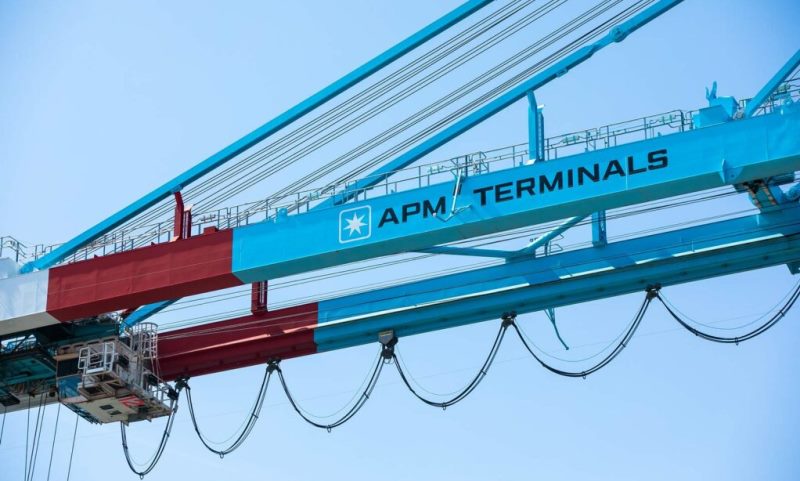
Maersk–APM has signed a concession agreement to develop a new container terminal at Tanger Med 3 in Morocco, marking a major expansion of the country’s port infrastructure and container handling capacity.
The agreement was announced by Morocco’s Royal Cabinet following a working session chaired by King Mohammed VI at the Royal Palace in Rabat. The meeting reviewed progress on the Tanger Med 3 project and preparations for the imminent commissioning of the first container terminal at Nador West Med.
Construction of Tanger Med 3 is expected to begin shortly. Located west of Tanger Med 2, the new terminal will feature 1,200 metres of quay and add an annual handling capacity of 4.5 million TEUs. The project involves an investment of 8 billion Moroccan dirhams.
The development forms part of a broader expansion programme covering Tanger Med’s passenger and roll-on/roll-off facilities, alongside the planned eastern extension of Tanger Med 2.
Upon completion of the proposed developments, the overall Tanger Med port complex could achieve an annual container handling capacity of 20 million TEUs, potentially placing it among the world’s 10 largest container ports, according to the Royal Cabinet.
Nador West Med Set for Initial Terminal Operations
The Royal Cabinet also confirmed that the first phase of Nador West Med’s initial container terminal is expected to commence operations within the coming days.
The terminal will eventually provide an annual handling capacity of 3.5 million TEUs. A second container terminal, with an additional capacity of 1.8 million TEUs, is scheduled to begin operations in April 2027.
The two container terminals together represent private investments of 8 billion dirhams. Total public and private investment in the wider Nador West Med port and industrial complex has reached 54 billion dirhams.
Beyond container handling, Nador West Med is being developed as an integrated industrial, logistics and energy hub, incorporating terminals for hydrocarbons, liquefied natural gas (LNG), dry bulk and general cargo.
Its energy infrastructure will include a storage zone with a potential capacity of four million cubic metres and an LNG terminal designed to handle up to five billion cubic metres annually.
The industrial zone is already operational, with one factory in production and three others under construction. The wider complex is expected to generate 14,000 direct jobs and 20,000 indirect jobs in the short term.
Major Transport Infrastructure to Support Growth
Supporting infrastructure projects include the Selouane–Nador West Med railway connection, the Guercif–Nador West Med motorway and improvements to the surrounding road network.
The simultaneous development of Tanger Med and Nador West Med underscores Morocco’s ambition to strengthen its position as a major international maritime, logistics and trade hub, enhancing its connectivity with European, African and global markets.
The projects are also expected to reinforce the country’s role in global supply chains by expanding container handling capacity and integrating port operations with industrial production, energy infrastructure and multimodal transport networks.