
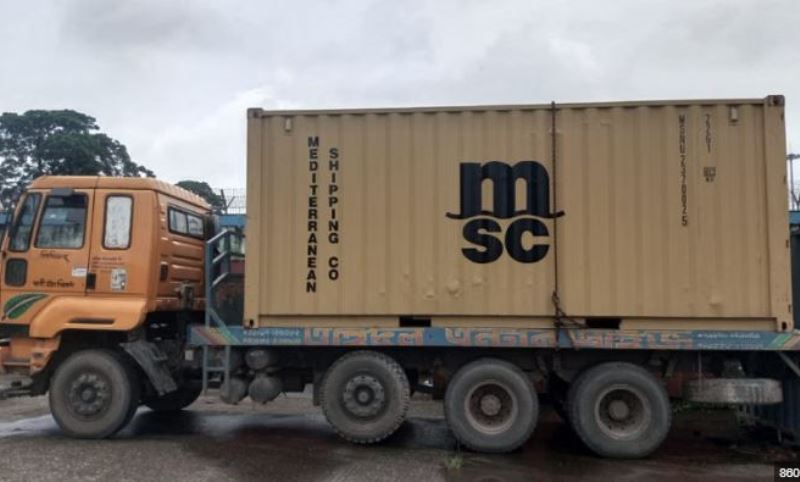
A container that arrived at Chattogram port via four other ports from Brazil has been found to contain radioactive material. The detection was made by the port’s Megaport Initiative Radiation Detective System. The Customs authorities have suspended unloading of the container.
The container in question contains scrap metal. Preliminary and secondary tests by the radiation detection equipment found three radionuclide isotopes inside: thorium-232, radium-226, and iridium-192.
Customs officials say the initial test showed a radiation level of one microsievert (a unit of radiation exposure). While this is not a high level, they cannot confirm the exact amount of radiation in the container before further testing, as the scrap metal and the container itself block accurate readings.
As a precaution, the container has been set aside in isolation.
Chattogram Customs records show that Al Aqsa Steel Mills Ltd, a rod-manufacturing plant in Demra, Dhaka, imported 135 tonnes of scrap metal from Brazil in five containers. The container that triggered the radiation alert was one of these five.
On 3 August, it was unloaded at the port from the vessel MV Mount Cameron at Jetty No. 9 of the JCB terminal. On Wednesday, as it was being cleared through Gate No. 4 of the port, the Megaport detection system sounded an alarm indicating the presence of radioactivity.
Chattogram Customs joint commissioner Mohammad Marufur Rahman told Prothom Alo that after the alert, unloading of the container was suspended and it was set aside in a separate location. “We are now notifying the Bangladesh Atomic Energy Commission by letter. Their scientists will come and conduct an on-site radiation test. Then necessary steps be taken,” he said.
Radioactive sources are used in a variety of fields including medicine, industry and research. During use, such sources are sealed in airtight, specially designed containers to prevent radioactive contamination. After use, these must be collected and managed as radioactive waste. However, due to negligence, accidents or other causes, such sources sometimes end up outside their containment, creating health and environmental hazards.
Alarm sounded in Chattogram after passing through four ports.
This correspondent traced the route of the container that triggered the radiation alert. Using the website of the Switzerland-based Mediterranean Shipping Company (MSC), it was found that the container was loaded with scrap metal in Manaus, a city in northern Brazil.
On 30 March, the container was placed on an MSC vessel at the port of Manaus. It was offloaded on 18 April at the port of Cristóbal in Panama. From there, on 3 May, it was loaded onto another vessel and taken to the port of Rotterdam in the Netherlands. From Rotterdam, it was loaded onto yet another vessel on 2 June and shipped to the port of Colombo in Sri Lanka, where it was offloaded on 15 July. Finally, on 28 July, the container was placed on the Chattogram-bound vessel Mount Cameron at Colombo’s South Asia Gateway Terminal and arrived at Chattogram port on 3 August.
Port websites show that three of the four ports along this route are equipped with radiation detection systems. Under international rules, if radioactivity is detected at these ports, the container must be sent back to its country of origin. However, as no such detection occurred, the container reached Chattogram without hindrance. Ultimately, it was the radiation detection system installed at Chattogram port in 2011 with US funding that detected the radioactivity.