
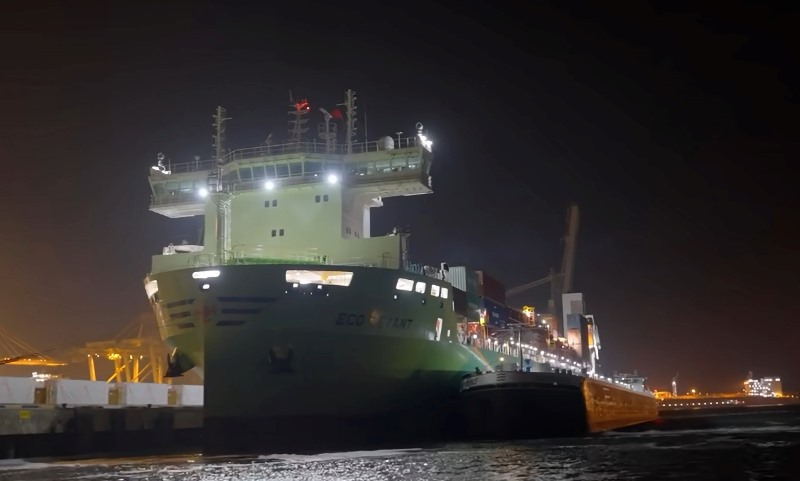
X-Press Feeders has successfully completed the bunkering of an ethanol-methanol marine fuel blend aboard its vessel Eco Levant at the Port of Rotterdam on 23 May 2026, marking another significant milestone in the company’s pursuit of practical low-emission fuel solutions for the maritime industry.
The fuel blend used during the operation consisted of 90% ISCC EU-certified biomethanol and 10% ISCC EU-certified second-generation ethanol. The bunkering process was carried out safely under controlled operational conditions as part of the company’s ongoing efforts to evaluate alternative fuel flexibility and support the transition towards scalable lower-emission shipping solutions.
According to the company, the initiative reflects its broader commitment to sustainability and decarbonisation in maritime transport, while also contributing to the industry’s growing exploration of cleaner fuel pathways.
The operation was supported by Eastaway Ship Management Pte. Ltd., whose team leveraged prior experience from earlier methanol bunkering projects to coordinate the planning and execution of the latest operation efficiently.
X-Press Feeders also acknowledged the support of its partners and stakeholders involved in facilitating the bunkering activity at the Port of Rotterdam, one of Europe’s leading hubs for alternative marine fuels and green shipping initiatives.
The successful operation further strengthens the role of methanol-based fuels in the maritime sector’s energy transition as shipping companies continue testing viable solutions to reduce greenhouse gas emissions and comply with evolving international environmental regulations.