
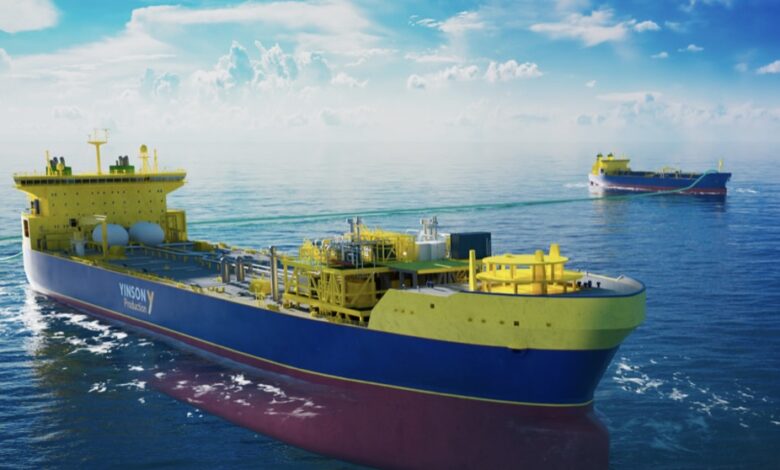
K Line Energy Shipping (KLES), a London-based subsidiary of Kawasaki Kisen Kaisha (K Line), and Yinson Production have agreed to jointly develop and market solutions for the transportation and injection of liquefied CO2. Under the memorandum of understanding (MoU), KLES and Yinson Production will jointly develop and market a floating storage and injection unit (FSIU) and a liquefied CO2 carrier. The collaboration will target carbon capture and storage (CCS) projects being developed mainly in Europe.
FSIUs are being considered for several projects, including the Havstjerne carbon storage project in Norway. The Havstjerne carbon storage project is 40% owned by Stella Maris CCS, a unit of Yinson Production.
Yinson Production operates a fleet of floating production, storage and offloading (FPSO) and floating storage and offloading (FSO) vessels while K Line has managed for the past year two liquefied CO2 carriers for the world’s first commercial CO2 transport and storage service.
K Line and Yinson Production have been working together in the FPSO sector since 2018. Both parties co-own FPSOs Anna Nery and John Agyekum Kufuor in Brazil and Ghana, respectively.
Kei Onishi, corporate officer of K Line, said: “By combining their offshore engineering expertise with our experience in CO2 shipping, we are developing an offshore unloading capability and bespoke transport solutions to serve a broader range of CO2 storage sites. This will complement traditional port-to-port transport models for the CCS value chain and offer emitters greater flexibility in meeting their decarbonisation goals.”
Pictured above, an illustration of an FSIU in the foreground, receiving cargo from an LCO2 carrier in the background.