
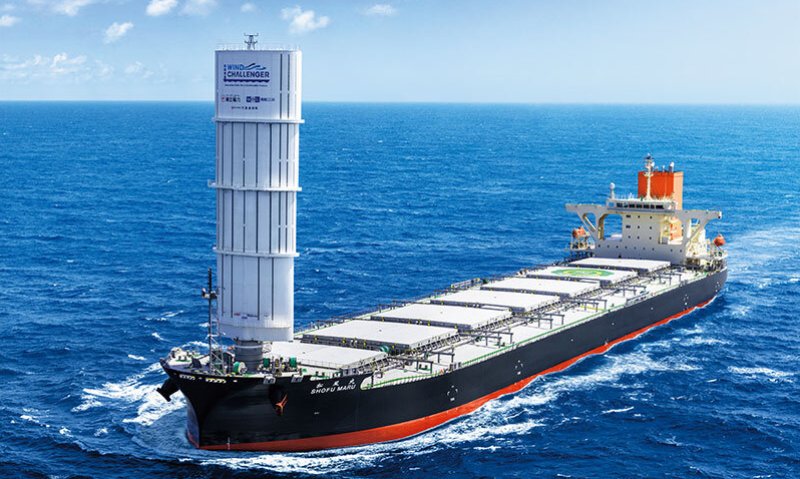
Mitsui O.S.K. Lines (MOL) announced the delivery of the vessel, which was built by Oshima Shipbuilding as a dedicated coal carrier for Kansai Electric Power Co., Inc. The vessel will transport coal to the company’s Maizuru Power Plant, supporting a stable electricity supply while reducing the environmental impact of shipping operations.
MAIZURU KAZENOMAI combines an LNG dual-fuel main engine with MOL and Oshima Shipbuilding’s jointly developed Wind Challenger, a hard-sail wind-assisted propulsion system designed to harness wind energy and reduce fuel consumption.
According to MOL, the combination of these technologies is expected to reduce CO₂ emissions by up to approximately 30% compared with conventional heavy fuel oil-fired vessels. The vessel is also expected to reduce greenhouse gas (GHG) and nitrogen oxide (NOx) emissions, while significantly lowering sulphur oxide (SOx) emissions.
The delivery represents another step in MOL’s efforts to improve vessel efficiency and reduce the environmental footprint of its fleet. Under its Environmental Vision – BLUE ACTION 2035 Phase 2, the company aims to achieve net-zero GHG emissions by 2050.
MOL plans to expand the deployment of Wind Challenger-equipped vessels to 25 by 2030 and 80 by 2035, strengthening the role of wind-assisted propulsion in its decarbonisation strategy.
The entry into service of MAIZURU KAZENOMAI highlights the growing application of wind-assisted propulsion and alternative-fuel technologies in specialised cargo shipping, as the maritime industry continues to explore ways to improve energy efficiency and reduce emissions.