
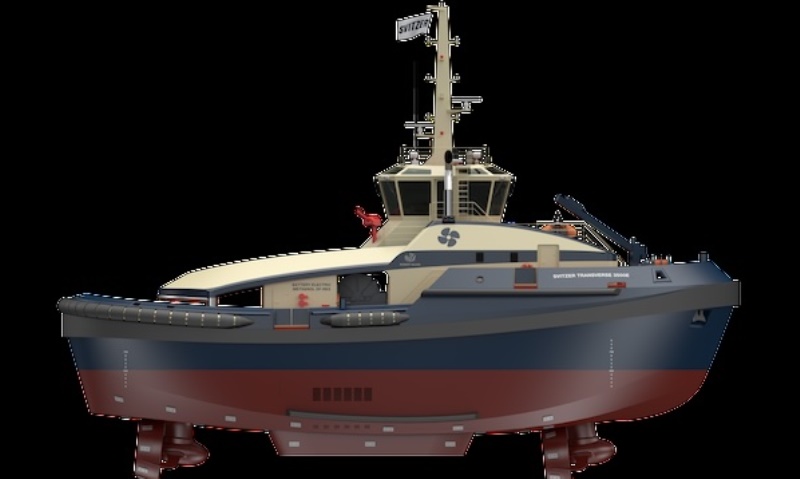
Svitzer, a global leader in towage services, has announced a groundbreaking contract with Turkish shipyard Uzmar to construct the world’s first battery-methanol tug.
The innovative vessel, designed for operations in the Port of Gothenburg, Sweden, represents a significant step towards sustainable maritime operations.
The new tug, based on Svitzer’s TRAnsverse design, will feature a 6MWh battery system supported by dual-fuel methanol engines for backup and extended range. It is expected to conduct over 90% of its operations using the battery-electric powertrain, significantly reducing carbon emissions.
Delivery is anticipated in the second half of 2025.
“This battery tug will bring a new dynamic to our operations,” said Kasper Nilaus, CEO of Svitzer. :There will not be a one-size-fits-all solution for us to meet our ambitious decarbonization targets, and equipped with this new power technology we have yet another option for how to significantly reduce emissions across the many global ports and terminals we operate in.”
The tug’s specifications ensure that sustainability does not come at the cost of performance . The vessel will feature an overall length of 34.9 meters, a bollard pull of 85 tonnes, and the ability to achieve speeds up to 14 knots. It will also utilize escort steering and braking forces rated at 150 and 200 tonnes, respectively, measured at 10 knots.
Gothenburg, aiming to become the world’s most sustainable port, provides an ideal location for the vessel as it invests more in shore power charging options and already offers methanol bunkering facilities.
“The battery electric tug will mean we can deliver our services to customers in the Port of Gothenburg with significantly lower carbon emissions, and still to the highest operational and safety standards,” said Gareth Prowse, Head of Decarbonization at Svitzer.
In February, Maersk announced its decision to spin off Svitzer as part of its strategic shift towards becoming an integrated logistics provider. The company’s Board of Directors approved a demerger plan for Svitzer A/S and its subsidiaries, which will result in the creation of a new independent entity called Svitzer Group A/S. After considering various options, Maersk concluded that listing Svitzer as a standalone company would be the most advantageous approach for long-term shareholder value creation.