
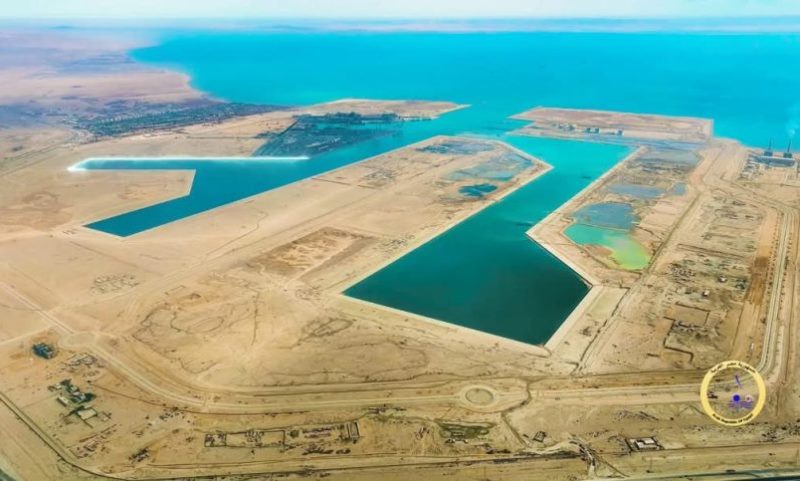
Egypt’s Ministry of Transport is moving forward with the development of the integrated Sokhna–Alexandria container logistics hub, a cornerstone of the country’s strategic vision to strengthen its global trade position.
The project aims to establish a seamless connection between the Red Sea and the Mediterranean, reinforcing Egypt’s role as a premier logistics and trade hub.
The first phase of the port’s expansion includes the Hutchison Container Terminal, where all infrastructure work has been completed. Construction has now begun on the superstructure, including the terminal yard, administrative buildings, and security fences.
Spanning a total area of 25 km², the port’s development includes five new basins and berths stretching 18 km with a depth of 18 meters, extending the total berth length to 23 km. Cargo handling yards covering 8.6 km² are also under construction, bringing the total yard space to 10.6 km². Additionally, logistics zones are being developed over 6.3 km² to support trade operations.
To enhance connectivity and efficiency, the project features the construction of 30 km of railway lines for both electric and diesel trains, as well as an internal road network with 17 km of concrete-paved roads, designed to prevent congestion and facilitate smooth cargo movement between berths and port facilities. Furthermore, wave barriers totaling 3,270 meters in length are being installed to optimize maritime operations.
This ambitious initiative is a key component of Egypt’s National Logistics Strategy, designed to modernize the country’s maritime transport infrastructure and position its ports as a vital gateway for global trade and investment.