
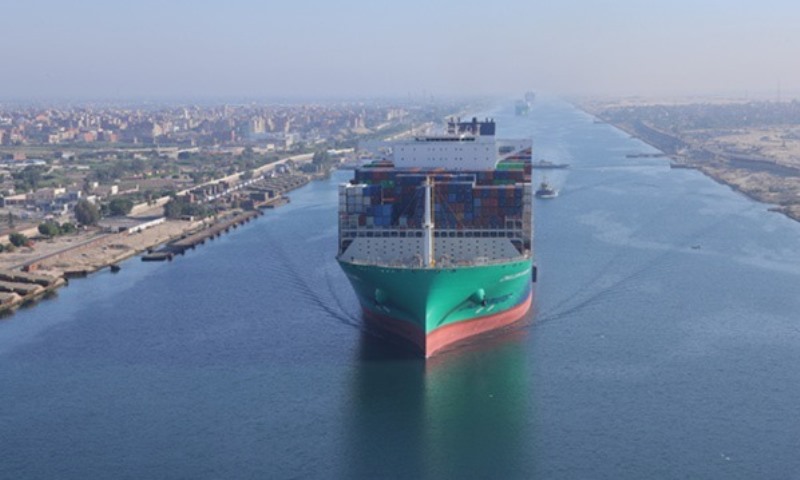
Nearly 63% of container shipping capacity deployed between the Far East and Europe has returned to routes through the Red Sea and Suez Canal, marking a significant shift after three years of diversions around the Cape of Good Hope. The latest figures indicate a gradual recovery in one of the world’s most important maritime trade corridors.
According to shipping consultancy Alphaliner, approximately 5.5 million TEUs of the 8.7 million TEUs deployed on Far East–Europe routes were operating on services using the Red Sea between September 15 and October 15, 2026.
The recovery varies by trade lane. Around 70% of capacity on Far East–Mediterranean routes has returned to the Red Sea, compared with approximately 58% on Far East–North Europe services. Of the 46 direct Far East–Europe services operated by the 10 largest carriers surveyed, 24 were transiting the Red Sea.
Major shipping lines resume Suez transits
Several leading container carriers, including CMA CGM, COSCO Shipping, OOCL, Maersk and MSC, have resumed Red Sea operations on selected services. Premier Alliance members HMM, Ocean Network Express (ONE) and Yang Ming are also preparing to restore additional services.
However, the return remains gradual. Some shipping lines are using the Suez Canal on westbound voyages to Europe while continuing to route return voyages around the Cape of Good Hope. Others are maintaining alternative routings as a precaution against renewed security disruptions.
Potential savings in transit time and fuel costs
The Suez Canal route offers a shorter connection between Asia and Europe than the longer passage around southern Africa. Returning to the route can reduce sailing times by around two weeks on some services, while lowering fuel consumption and vessel requirements.
These savings could help shipping lines improve vessel utilisation, restore schedule efficiency and reduce operating costs. Shippers may also benefit from more predictable transit times, although freight rates will continue to depend on capacity, demand and carriers’ pricing strategies.
Security concerns remain
Despite the growing number of transits, risks in the Red Sea remain a major concern. Shipping companies are retaining contingency plans that would allow them to return services to the Cape of Good Hope if the security situation deteriorates.
The gradual restoration of Suez Canal services is an important development for global supply chains. However, a full return to pre-disruption routing patterns will depend on sustained maritime security and shipping lines’ confidence in the stability of the corridor.