
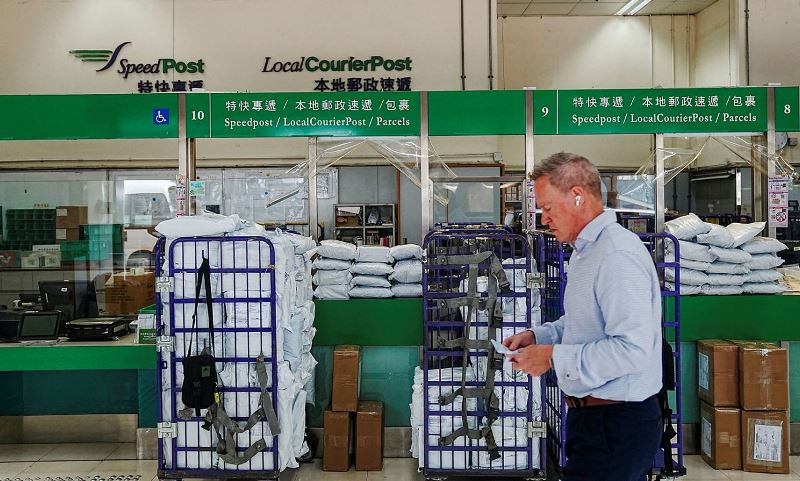
Hong Kong’s post office will stop shipping small parcels to the United States after Washington announced plans to charge tariffs on small-value parcels from the southern Chinese city, the government said Wednesday.
The US government earlier announced that it would end a customs exception allowing small-value parcels from Hong Kong to enter the US without tax, slapping a 120% tariff on them starting from May 2. The “de minimis” exemption currently allows shipments that are worth less than $800 to go tax-free.
A government statement said Hongkong Post would not collect tariffs on behalf of Washington, and will suspend accepting non-airmail parcels containing goods destined for the US on Wednesday, since items shipped by sea take more time. It will accept airmail parcels until April 27.
“For sending items to the US, the public in Hong Kong should be prepared to pay exorbitant and unreasonable fees due to the US’s unreasonable and bullying acts,” the government wrote.
It will continue accepting mail that contains only documents.
Hong Kong, is caught in the middle of the trade disputes between the US and China despite being a free port.
The former British colony, which returned to Chinese rule in 1997, has trade and customs policies different from mainland China’s, under the semi-autonomy granted by Beijing during the handover. But Washington began treating it as part of China after Beijing imposed a national security law in 2020, and has applied the 145% tariffs imposed on Chinese imports.
The national security law, which China says has brought back stability to the city, has virtually silenced all dissent.