
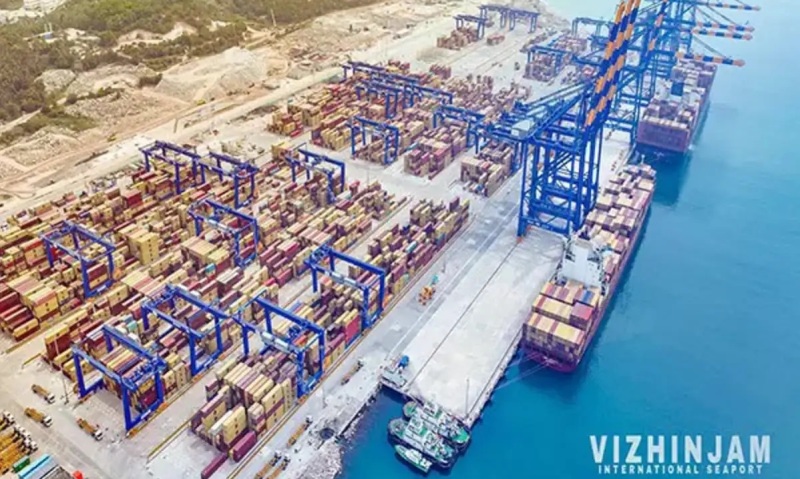
Adani Ports and Special Economic Zone (APSEZ) plans to develop a 100-acre Container Freight Station (CFS) near Vizhinjam International Seaport as part of its future expansion strategy, once export-import (Exim) cargo volumes grow and stabilize.
The port is scheduled to commence Exim container operations on August 18, but initially will handle only full-container-load (FCL) cargo due to the absence of a CFS. Without a CFS, containers cannot be opened for customs examination, sorting, consolidation or deconsolidation, making it impossible to process mixed cargo destined for multiple locations.
“The port will build a CFS when Exim operations pick up and stabilize. It is part of the future expansion plan,” a port official said.
At present, Exim containers will be transported by road between the port and customers. Rail connectivity is expected in the future, once the proposed 10-km railway link connecting Vizhinjam Port to the national railway network is completed, a project estimated to take around four years.
In parallel, the Kerala government is moving ahead with plans to establish a logistics ecosystem around the port, including a CFS, warehouses and other logistics infrastructure. Land acquisition and leasing processes have commenced, while memorandums of understanding (MoUs) have been signed with public sector undertakings to develop facilities that will support importers and exporters.
Officials also indicated that a temporary logistics facility could be considered depending on the volume of Exim cargo handled through the port in the initial phase.
The commencement of Exim services is expected to benefit exporters in southern India, particularly MSMEs in Coimbatore, Tiruppur and Tirunelveli, which currently rely on distant ports for international shipments. Using Vizhinjam is expected to reduce transit time, logistics costs and delays.
Following a recent review meeting, Customs authorities granted final approval for Vizhinjam Port to handle Exim containers, subject to operational restrictions until a permanent Container Freight Station is established.
Meanwhile, Adani Ports is also expanding the port’s capacity by reclaiming land to construct additional berths. The company expects around 30% of the port’s container traffic to eventually comprise Exim cargo, complementing its growing transshipment business.