
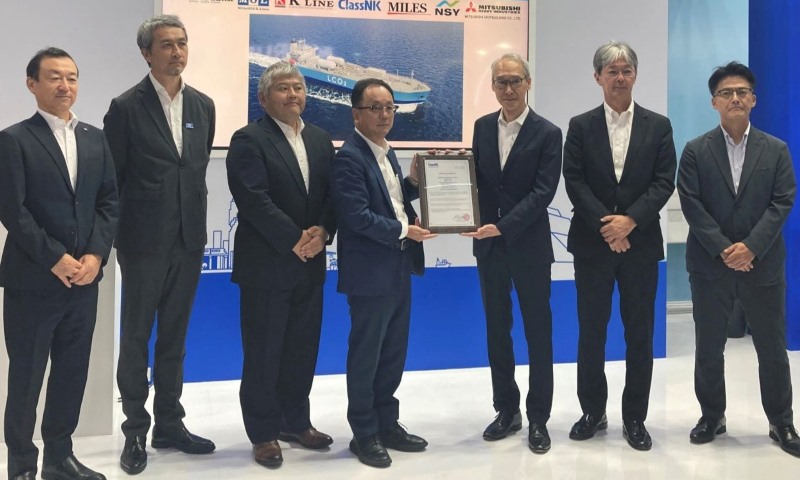
Mitsui O.S.K. Lines (MOL), Kawasaki Kisen Kaisha (“K” LINE), Nippon Yusen Kabushiki Kaisha (NYK Line), Nihon Shipyard, Mitsubishi Shipbuilding, and MILES Co. have secured Approval in Principle (AiP) from Japan’s classification society Nippon Kaiji Kyokai (ClassNK) for a standard low-pressure liquefied CO₂ (LCO₂) carrier.
The AiP follows completion of a risk assessment for LCO₂ handling operations and was presented at Gastech 2026 in Bangkok.
The six companies have been developing a standard design framework for LCO₂ carriers and low-carbon-fuelled vessels under a Memorandum of Understanding signed in December 2025. The initiative, which utilises MILES’ design capabilities, aims to promote standardisation, support domestic construction and supply of LCO₂ carriers, and establish a reliable CCS value chain in Japan.
The AiP represents the first concrete outcome under the MILES framework.
As part of the assessment, the companies conducted a Hazard Identification Study (HAZID) for LCO₂ handling operations on a standardised 42,000-cubic-metre-class low-pressure LCO₂ carrier. Drawing on the operational experience of MOL, K LINE and NYK Line in low-pressure gas carriers, the study identified risks specific to low-pressure LCO₂ operations and established a safety-focused design policy.
The resulting safety requirements will be incorporated into the standard design of future LCO₂ carriers. A common design platform is also expected to improve vessel design and construction efficiency while strengthening Japan’s capability to build vessels required for the emerging CCS market.
Demand for LCO₂ carriers is expected to increase as carbon capture and storage (CCS) projects get underway in Japan, requiring captured CO₂ to be transported by sea to offshore or other storage locations.
MOL, as part of its BLUE ACTION 2035 environmental strategy, is already expanding its involvement in the CCS value chain. The company has secured long-term charter contracts for two LCO₂ carriers for the Northern Lights project, the world’s first full-scale CCS project. The vessels are scheduled to begin CO₂ transportation services around 2028.
With maritime CO₂ transportation expected to expand alongside the development of CCS projects, the companies aim to accelerate the establishment of a safe, efficient and standardised LCO₂ shipping infrastructure in Japan.