
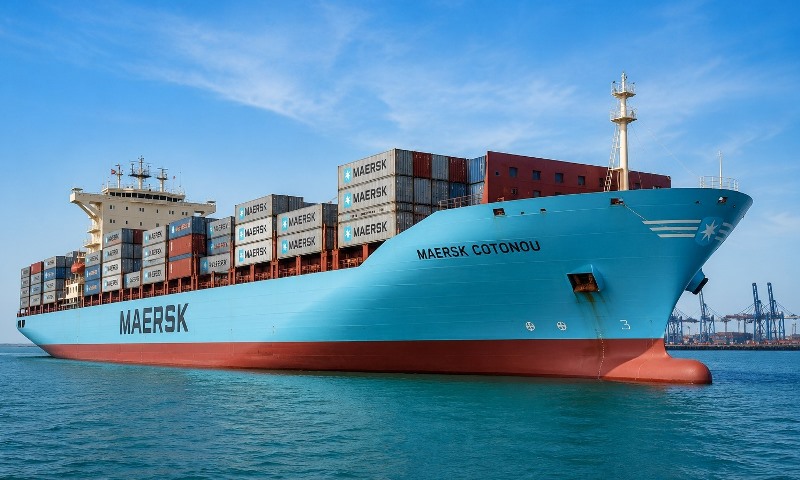
Maersk is preparing a major fleet expansion with plans to order 42 LNG dual-fuel container ships worth an estimated $8.9 billion, with Chinese shipyards expected to secure most, if not all, of the contracts.
The planned fleet comprises 12 24,000-TEU ultra-large container ships, 24 19,000-TEU vessels and six 18,600-TEU ships. South Korea’s Hanwha Ocean is reportedly competing with Chinese yards for the 24,000-TEU ships, which would be the largest vessels ever ordered by Maersk.
For the 24 19,000-TEU vessels, reportedly structured as 12+12 ships, negotiations are underway with Hengli Heavy Industries, which is understood to have an advantage due to its earlier delivery slots. The six 18,600-TEU ships are likely options held by New Times Shipbuilding, following Maersk’s February 2026 order for eight firm vessels plus six options of the same type.
The potential order reflects Maersk’s growing preference for Chinese shipyards, driven by earlier delivery capacity, competitive pricing and improving expertise in environmentally friendly dual-fuel ships. Chinese yards secured more than 80% of global container ship orders in the first half of 2026, while South Korean yards accounted for only around 10–15%.
The fleet expansion also signals a major shift in Maersk’s strategy. After years of maintaining a fleet capacity ceiling of around 4–4.4 million TEU while focusing on integrated logistics, the Danish carrier is now prioritising its core ocean shipping business. Its fleet has already grown to around 4.75 million TEU across 752 vessels, but prolonged capacity restraint has left limited room for further growth.
Competitive pressure is another key driver. MSC, which overtook Maersk as the world’s largest container carrier in 2022, has expanded its fleet to nearly 7.4 million TEU. Meanwhile, CMA CGM, currently ranked third, has indicated it could overtake Maersk by 2027, supported by an orderbook of around 1.7 million TEU, compared with Maersk’s approximately 1.2 million TEU.
Maersk’s proposed 42-vessel programme therefore marks a decisive departure from its previously conservative fleet strategy and underscores its ambition to strengthen its position in the increasingly competitive global container shipping market.