
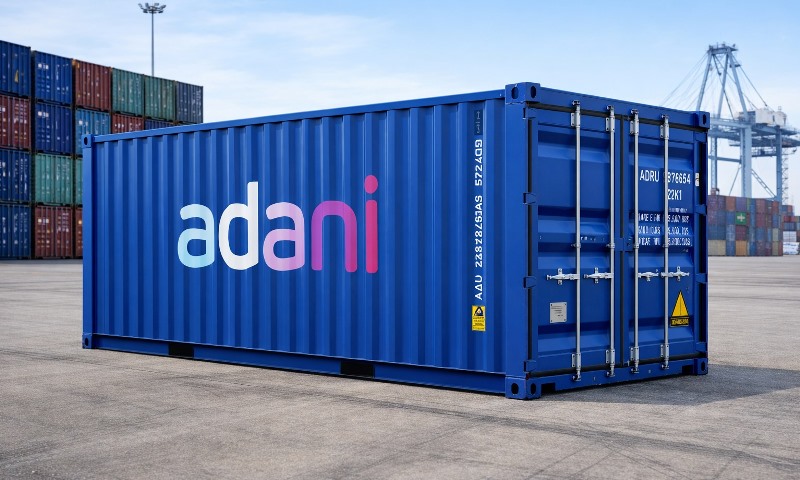
Adani Ports and Special Economic Zone Ltd (APSEZ) has incorporated a wholly owned subsidiary, Adani Container Manufacturing Ltd, to manufacture shipping containers with an annual production capacity of 3 lakh twenty-foot equivalent units (TEUs), as India steps up efforts to build domestic container manufacturing capabilities and reduce its dependence on China.
The new subsidiary was listed among APSEZ’s subsidiaries in the company’s second-quarter financial results announced on Wednesday. Its incorporation comes on the same day the Union Cabinet approved a ₹10,000-crore scheme to promote domestic container manufacturing.
With a proposed annual capacity of 3 lakh TEUs, the Adani venture is positioned to qualify for incentives under the government scheme, which provides capital expenditure subsidies and interest subvention on term loans for eligible manufacturing facilities.
Under the scheme, greenfield units must have a minimum annual production capacity of 1 lakh TEUs, while brownfield facilities must have a capacity of at least 25,000 TEUs to qualify for capital expenditure support. Eligible manufacturers will also receive a 3 per cent annual interest subvention on term loans taken to establish their facilities.
The scheme also provides operational expenditure (opex) assistance of ₹49,500 for every 20-foot container and ₹86,625 for every 40-foot container sold for domestic use or exports. This support will be linked to domestic value addition, with local content requirements starting at 70 per cent and progressively increasing to 90 per cent.
The opex subsidy will taper by 15 per cent annually between FY2035-36 and FY2037-38, followed by a 20 per cent annual reduction during FY2038-39 and FY2039-40. The maximum subsidy available to an individual applicant will be capped at ₹2,000 crore.
The 13-year scheme will cover the period from FY2027-28 to FY2039-40, comprising three years for commissioning manufacturing facilities and ten years of production support.
Reducing dependence on China
India’s push to develop a domestic container manufacturing industry comes against the backdrop of its heavy dependence on China, which accounts for as much as 95 per cent of global shipping container production. China manufactured approximately 8 million TEUs in 2024, while India’s installed manufacturing capacity stands at only around 70,000 TEUs annually.
Actual domestic production was just 24,000 TEUs in FY2023-24, highlighting the significant gap between India’s manufacturing capabilities and its growing logistics requirements.
The vulnerability of this dependence became particularly evident during the COVID-19 pandemic and subsequent Red Sea disruptions, when container shortages disrupted international trade and pushed container prices up by 300-400 per cent, according to a government official.
Indian manufacturers also face a cost disadvantage of approximately ₹50,000-₹75,000 per TEU compared with Chinese producers. Higher Corten steel prices, limited automation and economies of scale, and inadequate testing infrastructure are among the major factors affecting competitiveness.
Growing demand strengthens the case for domestic manufacturing
India’s expanding maritime trade and port infrastructure are expected to drive a substantial increase in container demand over the coming decades. The country’s port container throughput, estimated at around 24 million TEUs in 2024, is projected to reach 175 million TEUs by 2047.
The entry of APSEZ into container manufacturing, alongside the Centre’s new incentive framework, could provide fresh momentum to domestic production, strengthen supply-chain resilience and create a manufacturing ecosystem capable of supporting India’s long-term maritime and export growth ambitions.
Source: ET Infra