
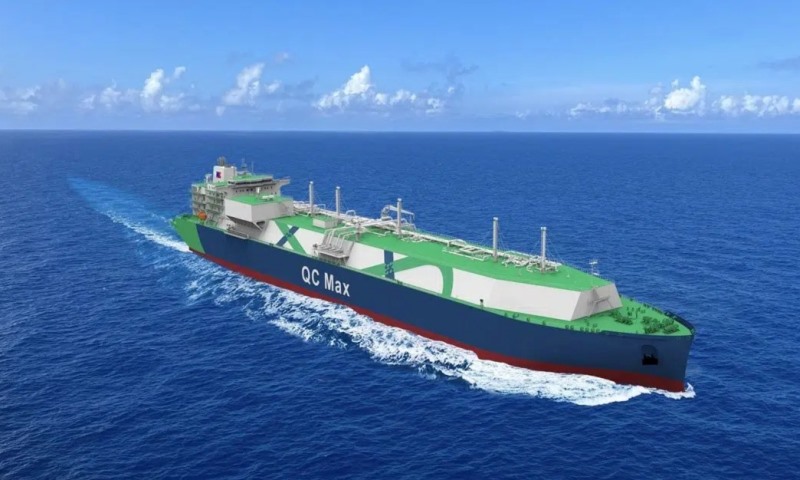
China’s Hudong-Zhonghua Shipbuilding has commenced construction of the world’s largest liquefied natural gas (LNG) carrier, marking a significant milestone in the country’s drive to strengthen its position in advanced shipbuilding. The new “QC-Max” vessel will feature a record cargo capacity of 271,000 cubic metres, making it the largest LNG carrier ever built.
Measuring 344 metres in length, the vessel will be equipped with China’s domestically developed NO96 Super+ membrane containment system, designed to safely store and transport LNG at extremely low temperatures. The carrier is expected to transport 57 per cent more cargo than the conventional 174,000-cubic-metre LNG vessels that currently dominate the global fleet.
The ship will also incorporate a dual-fuel propulsion system and an optimized hull design aimed at reducing fuel consumption and lowering carbon emissions. Built to comply with IMO Tier III environmental regulations, the vessel will be capable of calling at most major LNG terminals worldwide.
The project highlights China’s growing capabilities in the highly specialized LNG carrier sector, which has historically been dominated by a handful of international shipbuilders due to the complex engineering requirements involved in transporting super-cooled natural gas.
According to industry reports, China has now secured more than 30 per cent of the global LNG carrier market. Hudong-Zhonghua currently leads the sector with an orderbook of 60 LNG carriers, with its production slots fully booked through 2030.
The ultra-large LNG carrier is scheduled for delivery in 2028 and is expected to enhance LNG transportation efficiency while supporting the stability of global energy supply chains amid ongoing geopolitical uncertainties.