
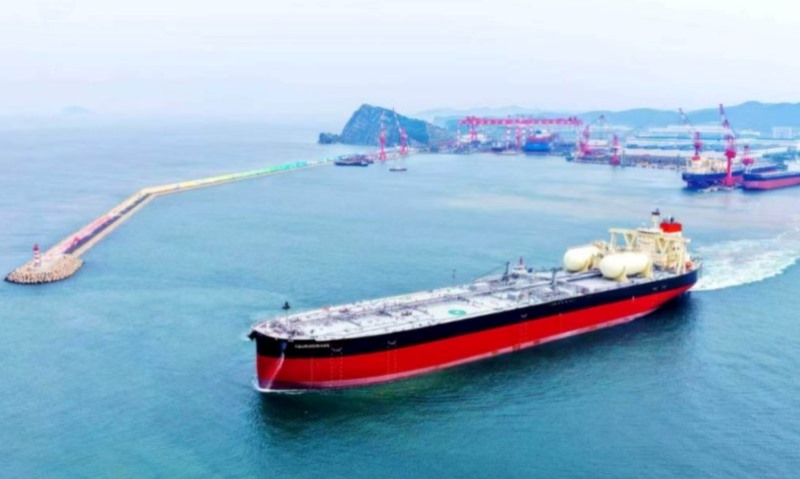
Mitsui O.S.K. Lines (MOL) has held the naming ceremony for its newbuilding very large crude carrier (VLCC) TSURUGIDAKE, built for Equinor ASA, a leading international energy company, at Dalian COSCO KHI Ship Engineering Co., Ltd. in China.
TSURUGIDAKE is the fourth LNG dual-fuel VLCC delivered by the MOL Group and the third LNG dual-fuel VLCC delivered by the group to Equinor under a time charter contract, following two earlier vessels.
The new VLCC is equipped with an LNG fuel tank with a capacity of more than 10,000 cubic metres, supporting long-distance voyages while providing greater operational flexibility. Its LNG dual-fuel capability is designed to enhance environmental performance and contribute to lower-emission maritime transportation.
MOL has also placed a strong emphasis on seafarer welfare and onboard comfort. TSURUGIDAKE features a dedicated relaxation facility named “IKOI”, designed as a “third place” separate from the crew’s living and working areas.
The IKOI facility includes a theater room and swimming pool, providing seafarers with opportunities to relax and unwind during extended voyages.
The delivery of TSURUGIDAKE further strengthens MOL’s LNG dual-fuel VLCC fleet while highlighting the company’s focus on both environmental performance and improved working conditions for seafarers.