
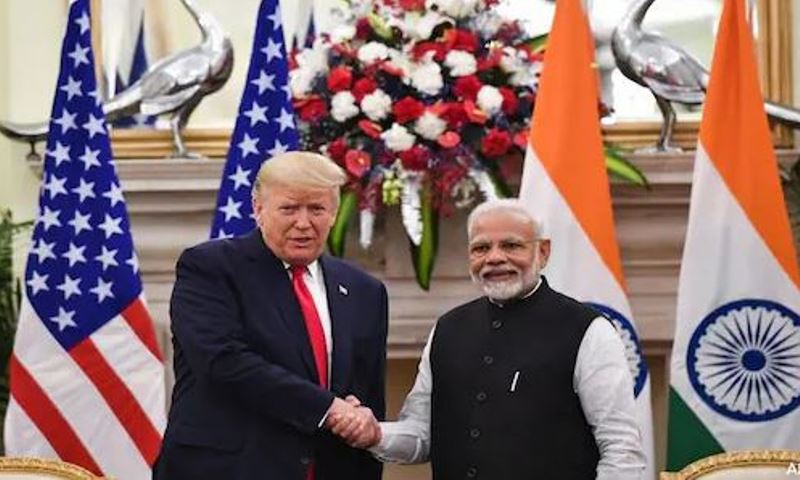
India is eager to expedite a trade agreement with the United States following US President Donald Trump’s unexpected decision to temporarily pause the implementation of reciprocal tariffs on many countries whilst increasing duties on China.
Trump announced an increase to 125% tariff on Chinese imports to maintain pressure on China, whilst the US reciprocal tariff for India remains at 10%.
In February, India and the United States had announced plans to complete the initial phase of a trade agreement by autumn 2025, with the objective of achieving bilateral trade of $500 billion by 2030.
“The 90-day pause on reciprocal tariffs is a relief for Indian exporters, especially shrimp exporters,” a government official said.
The official noted that India was amongst the earliest nations to initiate trade deal discussions with the United States, having mutually agreed upon a completion deadline.
The official further indicated that international export and trade patterns would continue to be influenced by the trade tensions between the United States and China.
On Wednesday, Trump provisionally reduced duties on trading partners including India, merely 24 hours after implementing steep tariffs that triggered the most significant stock market turbulence since the early stages of the COVID-19 pandemic.
According to a report, India has expressed openness to consider duty-free imports from the US across multiple sectors, including those covered under PLI schemes. A comprehensive offer from India could expedite the proposed bilateral trade agreement.
The PLI scheme currently spans 14 distinct sectors with an allocated budget of Rs 1.97 lakh crore. These sectors include mobile phones, drones, white goods, telecom, textiles, automobiles, specialty steel and pharmaceuticals.
Meanwhile, shifting focus to GDP growth amidst the ongoing global turmoil and declining inflation, the Reserve Bank of India has cut the repo rate by 25 basis points to 6%. RBI governor Sanjay Malhotra has warned of heightened risks to India’s GDP growth with the trade war uncertainties.
“The recent trade tariff related measures have exacerbated uncertainties clouding the economic outlook across regions, posing new headwinds for global growth and inflation,” Sanjay Malhotra said in the monetary policy statement.
“The global economy is going through a period of exceptional uncertainties. The difficulty to extract signal from a noisy and uncertain environment poses challenges for policy making,” he said.