
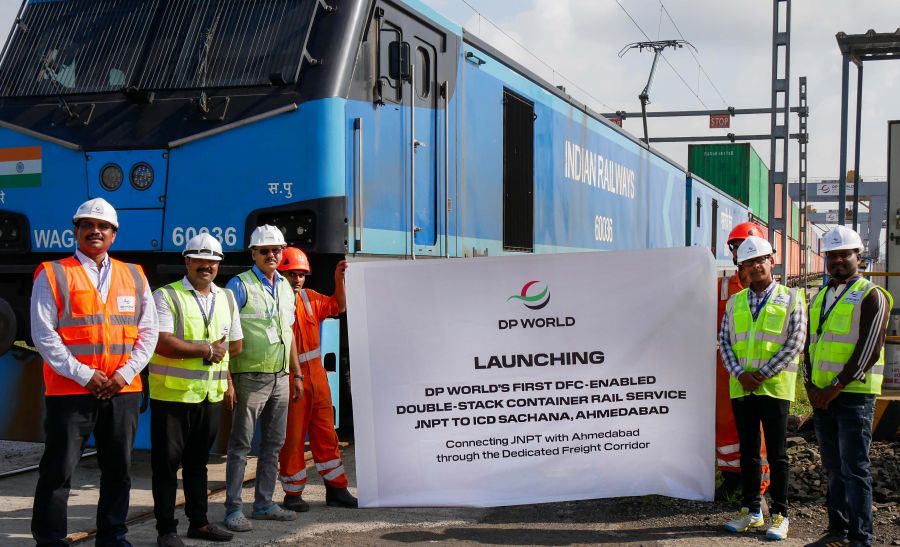
DP World has launched two new Dedicated Freight Corridor (DFC)-enabled double-stack rail services connecting Jawaharlal Nehru Port Authority (JNPA) with its inland container depots (ICDs) in the National Capital Region (NCR) and Sachana in Gujarat, strengthening multimodal logistics connectivity between India’s key maritime gateway and major inland markets.
The first service, effective September 2026, connects JNPA with DP World’s ICD network at Pali/Rewari, Jhattipur–Panipat and Modinagar in the NCR. The second service links JNPA with ICD Sachana in Gujarat, extending double-stack rail connectivity to the state’s industrial and commercial clusters.
The new services leverage dedicated freight infrastructure, higher speeds and increased rail capacity to facilitate the efficient movement of cargo between the port and inland markets. They are expected to support improved transit times, more predictable cargo movement and better supply chain planning for exporters, importers and domestic businesses.
By integrating port infrastructure, dedicated freight corridors and inland container depots, DP World aims to strengthen connections between maritime gateways and major production and consumption centres across North India and Gujarat.
Strengthening Multimodal Logistics
Double-stack rail operations enable more containers to be transported in a single train movement, increasing freight capacity and improving the efficiency of rail-based logistics. Greater use of rail can also reduce dependence on road transportation, contributing to lower road congestion and a more sustainable freight network.
Hemant Kumar Ruia, Country Manager, Subcontinent (India), DP World, said expanding double-stack rail connectivity through the Dedicated Freight Corridor was an important step towards improving the efficiency of India’s logistics sector.
As the economy grows, moving goods faster and more cost-effectively between ports and key markets will become increasingly critical, he noted. By connecting JNPA with major markets across the NCR and Gujarat, DP World aims to help businesses accelerate cargo movement, reduce logistics costs and build stronger, more resilient supply chains.
Adhendru Jain, Vice President – Rail & Inland Terminals – SCO, DP World, said India’s National Logistics Policy and PM GatiShakti were driving the development of a more integrated, multimodal and efficient logistics ecosystem through stronger connections between ports, rail networks and inland markets.
He said the expansion of DFC-enabled double-stack rail services aligned with this vision by increasing rail capacity and strengthening links between maritime gateways and key production and consumption centres. Integrating JNPA with DP World’s ICD network across the NCR and Gujarat would offer customers more efficient and predictable cargo movement, greater flexibility in transportation choices and access to a more cost-efficient, resilient and sustainable freight network.
Supporting Key Industrial Sectors
The new rail services are expected to benefit major production and consumption clusters across Gujarat and North India, particularly the automotive, engineering, manufacturing, pharmaceutical, chemical, textile and home-furnishing sectors.
By providing stronger rail connections to JNPA, the services will offer exporters, importers and domestic supply chains greater freight capacity and more reliable cargo movement.
The expansion reinforces the role of DFC-enabled double-stack rail operations in improving port-to-hinterland connectivity and advancing India’s transition towards an integrated, capacity-driven and sustainable multimodal logistics system.