
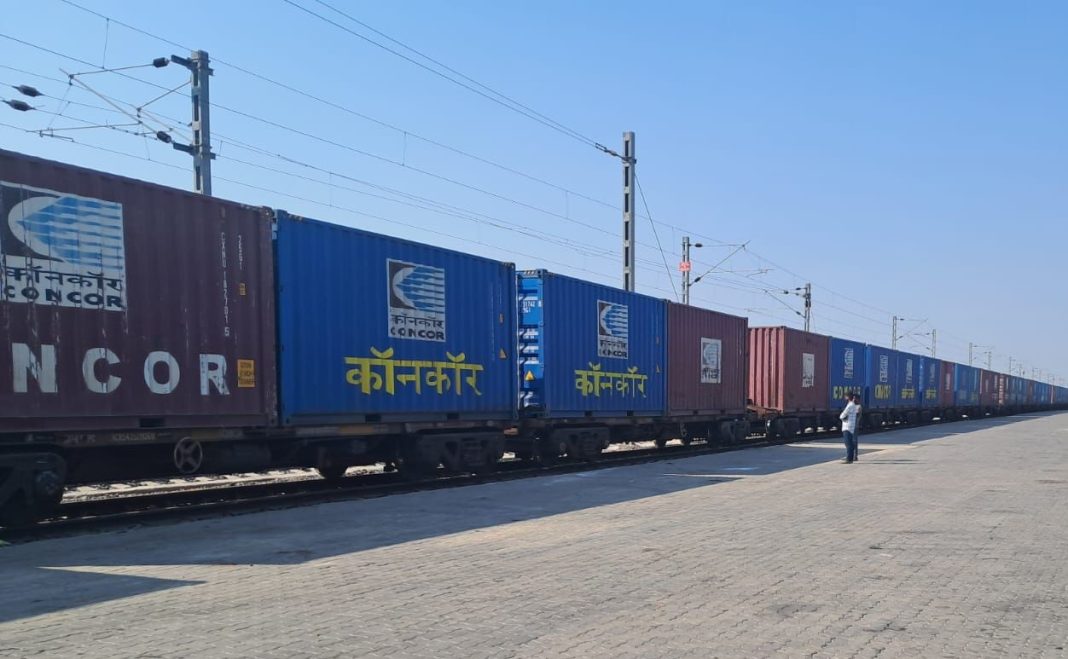
India has sought permission for private container train operators to run freight trains directly into Bangladesh and transport containers to inland destinations using the neighbouring country’s railway network, as part of efforts to strengthen cross-border rail connectivity and improve freight movement.
The proposal was discussed at the 38th Bangladesh-India Inter-Governmental Railway Meeting held in Dhaka from September 8 to 10, according to the meeting minutes. Bangladesh, however, maintained that Indian Railways would have to assume full responsibility and liability for the operations of any private Indian container train operator permitted to run within its territory.
Currently, Indian government and private container trains transport containers up to the Indian side of the Benapole border, after which the cargo is transferred to local trailer trucks for onward movement to inland container depots and other destinations in Bangladesh.
India also proposed round-the-clock freight train operations on three cross-border routes — Darshana-Gede, Petrapole-Benapole and Rohanpur-Singhabad — replacing the existing sunrise-to-sunset operating schedule. Bangladesh said the proposal could be considered based on the volume of cross-border trade, noting that freight movement had declined over the past two years but was recently showing signs of recovery.
The Indian delegation also sought faster acceptance of freight trains at the Rohanpur-Singhabad interchange, citing delays that leave Indian wagons and locomotives stranded for extended periods. Bangladesh attributed the limitations to locomotive availability, manpower shortages and railway line capacity, suggesting that additional freight movement be routed through other interchange points.
To improve freight handling, Bangladesh said work was under way to increase the clear standing length at 12 freight unloading stations, while capacity expansion was also progressing at Sirajganj Bazar, Ibrahimabad, Nawapara, Faridpur and Ullapara. It also said steps were being taken to reduce the turnaround time of Indian wagons to below five days.
India proposed direct freight booking between railway stations in the two countries to ease congestion at border points. Bangladesh said this would require amendments to existing bilateral railway traffic exchange regulations and favoured continuing the present rebooking arrangement for the time being due to limited wagon-receiving capacity at domestic stations.
Other Indian proposals included increasing the authorised carrying capacity of BCN and BCNA wagons to 63 tonnes and 66 tonnes, respectively, allowing full-length 45-wagon container trains at Benapole, revising freight charges and permitting open-top container movement. Bangladesh said the higher axle-load proposal would require route-specific assessment, while Benapole could accommodate full-length trains but lacked equipment to unload open-top containers.
The two sides also discussed expanding freight connectivity between Chattogram Port and Nischintapur in Tripura, including the possibility of passenger train services between Dhaka and Nischintapur. Bangladesh sought cargo demand forecasts and formal proposals from India before considering the initiatives.
The meeting further reviewed railway infrastructure projects, including the Kulaura-Shahbazpur rail link and the Dhaka-Tongi-Joydebpur project. Bangladesh cited financial difficulties faced by an Indian contractor and shortages of construction materials for delays in the Kulaura-Shahbazpur project. India sought payment of Tk 450 million in outstanding VAT dues to the contractor and assured that construction materials for the Dhaka-Tongi-Joydebpur project would be supplied promptly.
Financial reconciliation between the two railway administrations also remained an issue. India reported receivables of Rs 3.9099 billion as of June 2026, while Bangladesh claimed net receivables of Tk 2.1384 billion from Indian Railways. Bangladesh said it had initiated steps to pay Tk 500 million in outstanding passenger train-related dues. Both sides agreed to update their accounts regularly and reconcile pending payments.
Passenger rail connectivity was also discussed, with India proposing customs and immigration facilities throughout the journey of the Bandhan Express and operation of the Maitree Express via the Padma Bridge. Bangladesh said the Bandhan Express proposal would be reviewed based on passenger demand and practical considerations, while India was asked to submit a formal proposal through diplomatic channels for the Maitree Express route change.
The discussions also covered railway electrification, regulatory updates, station development and training. The next Bangladesh-India Inter-Governmental Railway Meeting is scheduled to be held in India in September 2027.