
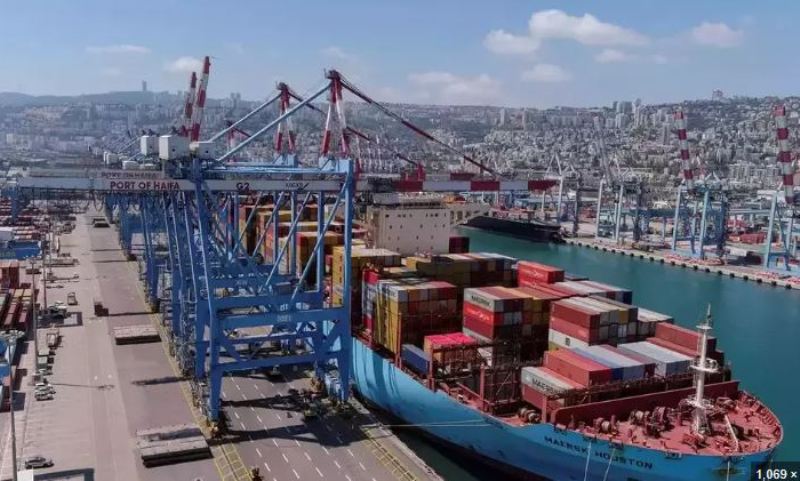
The controlling owner of the Haifa Port, the Adani Group, recently dismissed CEO Udi Sharon. However, the issues at the port are far from resolved. There is friction between Adani and the Israeli shareholder in the port, partly because the chairman of the board, Ron Malka, has adopted a confrontational stance against the state’s intention to increase competition in the ports. Meanwhile, other ports are strengthening and receiving regulatory relief.
On Wednesday, an unusual meeting took place at the Ministry of Transport offices in Tel Aviv. The two Indian CEOs from Gautam Adani’s multi-billion-dollar ports company met with Minister of Transport Miri Regev, Moshe Ben Zaken, Director General of her office, Ministry of Finance personnel, and other professionals. This meeting was arranged after Transport Minister Regev visited India last week and met with Adani executives. The CEOs, Ashwani Gupta and Sandeep Mehta, had another reason for their visit: this week, Mehta, who serves as director of the Adani-controlled Haifa Port, informed the ousted CEO Udi Sharon of his dismissal, alongside Chairman Ron Malka.
The decision to remove CEO Sharon was first reported last month, but the official reasons for his dismissal have not yet been made public. The formal reason for the dismissal was “exceeding the authority” of the CEO in negotiations with the port’s workers’ committees last year, which allegedly led to the board’s loss of confidence in him. However, it seems the official reason is primarily intended to provide a legal justification for the dismissal.
The decision to oust Sharon was not unanimous within the company. It passed by a narrow majority of 5 directors to 4, with Gadot representatives and directors Aharon Fogel and Rafi Danieli voting against the decision, while Adani representatives, who hold a structured majority, supported it. The division in the board of directors reflects a broader conflict between the Adani and Gadot shareholders. The friction began with Adani’s purchase of the port for the exorbitant price of 3.9 billion shekels (over $1 billion), which was 1.5 billion shekels higher than other offers. The main point of contention centers around port regulations promoted by the Ministries of Transport and Finance. These regulations aim to increase competition in the ports and reduce regulatory restrictions. The new arrangement will allow the Gulf Port and South Port to handle general cargo temporarily and provide additional benefits to the Port of Ashdod, Israel Shipyards, and the Haifa Port.
The chairman of Haifa Port decided to oppose the state’s intention to grant regulatory relief to all ports (especially the neighboring Gulf port controlled by the Chinese SIPG company), while Gadot and the CEO believed the port should cooperate with the state and achieve specific goals. The differences in opinion intensified with the removal of Sharon, which was carried out without Gadot’s consent. Gadot was also upset by the manner of the dismissal and the unilateral actions led by Malka. Despite this, both Adani and Gadot want to repair their relationship and currently have no intention of ending their partnership. Meanwhile, it has learned that Adani officials who arrived in Israel also met with Gadot representatives to resolve the issues, without Malka’s presence.
The senior delegation’s visit also signals Adani Group’s intention to increase its involvement in the port’s daily management. There are claims that Israeli management has not accurately conveyed the situation to the Indians. Adani even considered appointing an Indian CEO to replace Sharon, but this is unlikely due to existing agreements with the state. With Sharon’s dismissal, shareholders may now scrutinize Chairman Malka’s performance more closely.
The dismissal of the CEO is not the only challenge facing the Port of Haifa. Earlier this week, the Gulf Port began unloading vehicles for the first time, with 4,500 cars arriving at the new dock. Vehicle unloading is a particularly lucrative sector in the port industry, and the Gulf Port’s entry into this field is seen as a significant development. Since the outbreak of the war, the Port of Haifa has benefited from the closure of the Port of Eilat, significantly increasing its vehicle unloading operations. Similarly, the Port of Israel Shipyards has achieved a historic milestone after restrictions were lifted, allowing it to further enhance competition against other ports, including Haifa.
These events underscore the problematic nature of Haifa Port’s strategy, which opposes port regulations. The Ministries of Transport and Finance claim that Haifa Port is the only obstacle to these regulations and that they will continue to advance them with or without the port’s cooperation—evidenced by the decision to lift restrictions on Israel Shipyards. The meeting between Adani representatives and MK Regev, Ben Zaken, and other officials may indicate a shift in Malka’s strategy. During the meeting, it was decided to form work teams to address the port’s requests, including the possibility of competing with Israel Shipyards in the cement sector. Regev informed Adani that she intends to sign the settlement before the holidays, with or without their participation.