
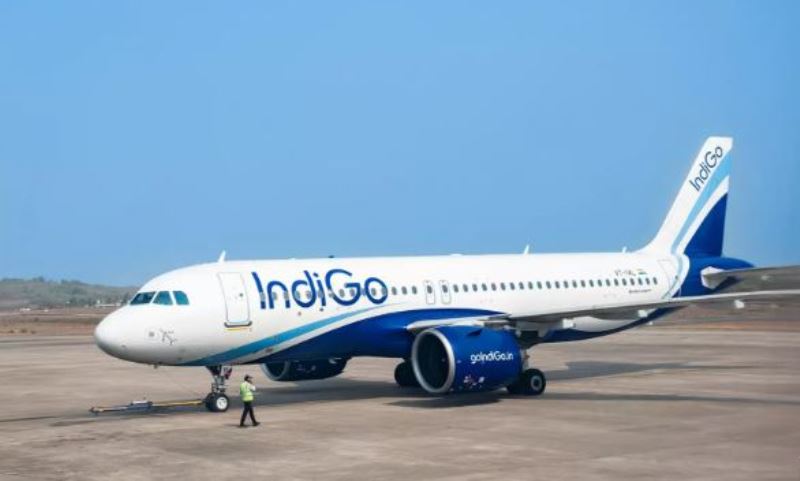
In a major development, India’s largest airline, IndiGo, has received a six-month extension from the Directorate General of Civil Aviation (DGCA) until February 28, 2026, to operate two leased Boeing 777 aircraft from Turkish Airlines.
Notably, two Turkish Airlines Boeing 777-300ERs are operating with IndiGo, registered as TC-LKD and TC-LKE. TC-LKD is 16.3 years old and TC-LKE is 18.5 years old, with both aircraft under a wet lease agreement from Turkish Airlines.
Both aircraft are currently deployed on the Delhi–Istanbul (6E11/6E12) and Mumbai–Istanbul (6E17/6E18) routes.
The current extension reflects in the flight schedule, with operations now set to continue until February 28, 2026, instead of the earlier deadline of August 31, 2025.
“We acknowledge the acceptance of IndiGo’s request for extension to its wet lease arrangement with Turkish Airlines, subject to conditions laid down by the regulator. This approval comes at a crucial time and will help mitigate losses to the Indian aviation industry due to geopolitical restrictions and greatly benefit Indian travellers during the peak travel season by ensuring a seamless, direct connection to Istanbul and points beyond. Given the current geopolitical challenges, this extension provides much-needed continuity and stability in operations, allowing us to better serve the growing demand for international travel. We are thankful to the authorities for accepting our request for an extension. As always, we continue to be fully compliant with the relevant regulations and conditions of extension laid down by the authorities,” an IndiGo spokesperson said.
Although the extension has been granted until February 28, 2026, flight booking data shows that from March 1, 2026, capacity on the Delhi–Istanbul and Mumbai–Istanbul routes will shift from the leased Boeing 777s to IndiGo’s Airbus A320neo.
In May 2025, DGCA rejected IndiGo’s request for a six-month extension of its wet lease with Turkish Airlines, citing national interest concerns. The underlying issue was geopolitical, as Turkey had openly supported Pakistan during the recent India–Pakistan conflict, Operation Sindoor, triggering domestic backlash.
The Boeing 777-300ER can carry about 21 tonnes of belly cargo in addition to a full passenger load, providing a significant boost to IndiGo’s cargo capacity.
IndiGo currently operates one Boeing 787-9 Dreamliner, registered LN-FNC, on wet lease from Norwegian long-haul carrier Norse Atlantic Airways. In addition, the airline has five more aircraft on wet lease from Norse, with another 3–4 scheduled for delivery by October–November this year and the remainder expected early next year. The aircraft is presently deployed on the European routes Mumbai–Amsterdam and Mumbai–Manchester.
In a recent interview in New Delhi, Mark Sutch, Head of International Development and Chief Commercial Officer, Cargo at IndiGo, said the airline’s expansion into long-haul
markets will unlock substantial belly cargo capacity. He added that IndiGo aims to extend its European network further, with Copenhagen and London scheduled as the next destinations by mid-October this year.
IndiGo has 60 Airbus A350-900s on order, scheduled to join its fleet from 2027. Each aircraft will provide an estimated bellyhold cargo capacity of around 18 tonnes.