
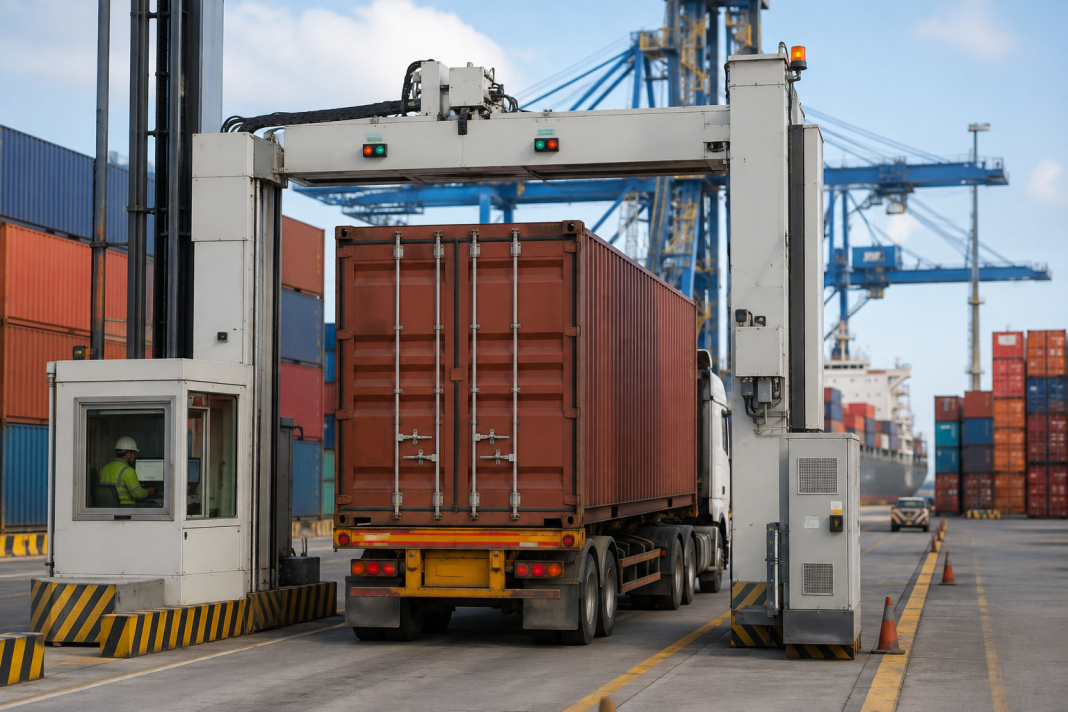
Port authorities and terminal operators are discussing a government proposal to make scanning mandatory for all export and import containers passing through Indian ports, a move industry stakeholders fear could cause significant delays and operational disruption, particularly during the initial phase of implementation.
“Every box, whether it is export or import, will have to be scanned. It’s a proposal now, but it will come. We are preparing as to how we ensure that it doesn’t lead to chaos and delays,” a senior executive at one of India’s leading container terminals said.
The proposal was discussed recently by the Jawaharlal Nehru Port Authority (JNPA), India’s largest state-owned container gateway, with container terminal operators and other stakeholders.
Industry representatives have raised concerns over the proposed shift from the existing risk-based scanning system. “The current system has been operational for many years. Security is important, but this proposal is unnecessary. It will lead to delays. The terminals are sceptical about the plan because it will impact their operations,” a trade source said.
At present, Indian ports follow a risk-based, non-intrusive inspection system managed by Customs through the ICEGATE electronic data interchange. Containers are selected for scanning through automated risk profiling based on factors such as manifest information, cargo type, importer profile and origin.
At JN Port, containers identified through the electronic Risk Management System (RMS) are scanned using mobile and drive-through X-ray systems. JNPA currently has five container scanners—three mobile X-ray scanners and two drive-through scanners—with three additional scanners under commissioning.
The scanning process generally takes around 25–30 seconds per vehicle. Containers that are cleared without anomalies proceed through the normal customs clearance process, while those flagged as suspicious are subjected to further physical examination.
However, the proposed move towards scanning every container is raising concerns over capacity and cargo evacuation, particularly for rail-bound containers.
Over the past four years, the proportion of containers scanned at JN Port has increased from around 3–4% to 12–15%, according to the terminal executive. The increase has already created operational challenges, particularly for containers moving by rail.
For road-bound import containers, container freight stations (CFSs) can facilitate scanning before cargo evacuation. Rail-bound containers present a more complex challenge because CFSs are generally not involved in the movement.
“Containers hauled by rail are a big problem. CFS does not come into the picture. Hence, the shipping lines have to figure out how to scan the rail containers, get them scanned from outside, bring them back and put them on trains,” the executive said.
Shipping lines have been seeking solutions from terminal operators to address the issue. The proposed mandatory scanning requirement could further increase the operational burden if adequate infrastructure is not put in place.
Stakeholders also discussed the possibility of replacing mobile scanners, through which container-laden trucks currently pass, with inland scanning facilities. “Now they want inland scanning; they don’t want the mobile scanners,” the trade source said.
Industry representatives have stressed that if inland scanning facilities are introduced for road-bound containers, similar infrastructure should also be developed for rail cargo to avoid bottlenecks and additional handling.
The port authority is examining scanning technologies and systems that can support the proposed mandatory scanning regime while ensuring smooth cargo movement. The plan is expected to involve greater use of non-intrusive inspection technologies, advanced imaging and artificial intelligence for risk assessment.
The proposed expansion follows the government’s Budget 2026 announcement that non-intrusive scanning using advanced imaging and AI technology would be expanded in a phased manner to scan every container across major ports.
While the proposed system is aimed at strengthening cargo security and preventing smuggling and misdeclaration, port and terminal stakeholders are seeking adequate infrastructure, capacity and operational safeguards to ensure that mandatory scanning does not result in congestion, additional handling and delays across India’s container supply chain.