
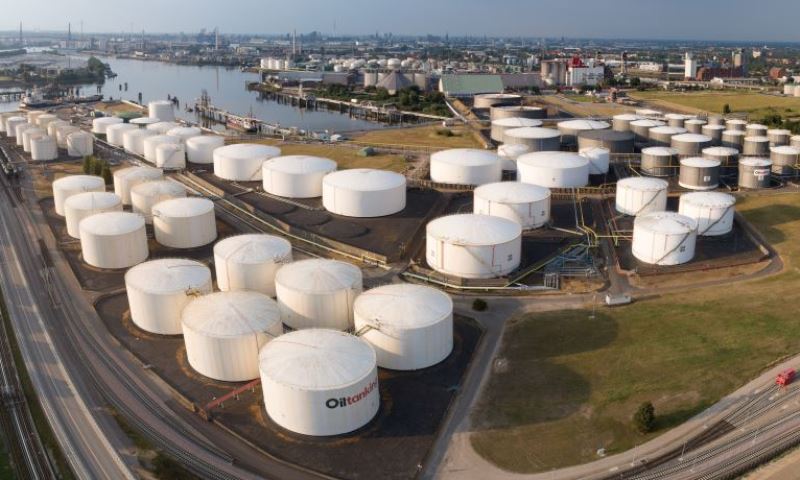
The Port of Hamburg has reported on Mabanaft’s aim to enable the storage of methanol at Blumensand and facilitate the import of low-carbon methanol to northern Germany.
While the tanks are planned to be retrofitted from mid-2025, the methanol storage is scheduled to start in 2027. Mabanaft intends to import the methanol itself and then store and distribute it in Germany and possibly other locations.
By deciding to apply for the necessary approvals in January this year, the company is willing to take on this multi-million-euro investment. The project requires the successful completion of an approval process with the Hamburg Authority of Environment, Climate, Energy and Agriculture (Behörde für Umwelt, Klima, Energie und Agrarwirtschaft, BUKEA).
The four tanks that would be converted have a total capacity of approximately 20,000 cubic metres. Subject to the necessary approvals, their conversion is planned to be carried out in two stages: the first two tanks by mid of 2026 and the further tanks in 2027.
Mabanaft is working with both existing and new customers to develop solutions for decarbonising their fuel needs.
“CO2-reduced methanol can be produced in several ways: through e-methanol synthesis using renewable electricity and captured CO2, through biomethanol production from biomass, or through the production of so-called blue methanol from natural gas with carbon capture and storage,” explained Joost Vespermann, Business Developer in Mabanaft’s Sustainable Fuels division.
“All these types of low-carbon methanol can be used in the future, depending on regional legislation and customer preferences.”
“In the shipping industry, there is no single solution for sustainable fuels,” explained Oleksandr Siromakha, Head of Sustainable Fuels at Mabanaft.
“That’s why we are committed to offering our customers a diverse range of options tailored to their needs – both now and in the future. Alongside conventional fuels, we currently offer bio-blends and want to provide more tailored solutions such as hydrogen, ammonia, and methanol.
“Our goal is to simplify the transition for our customers by making methanol and other alternative fuels more accessible. The challenges of decarbonisation are great. We are here to support our customers every step of the way.”
Earlier this month, Hamburger Hafen und Logistik AG (HHLA) Project Logistics successfully completed its first loading operation at the Port of Hamburg.