
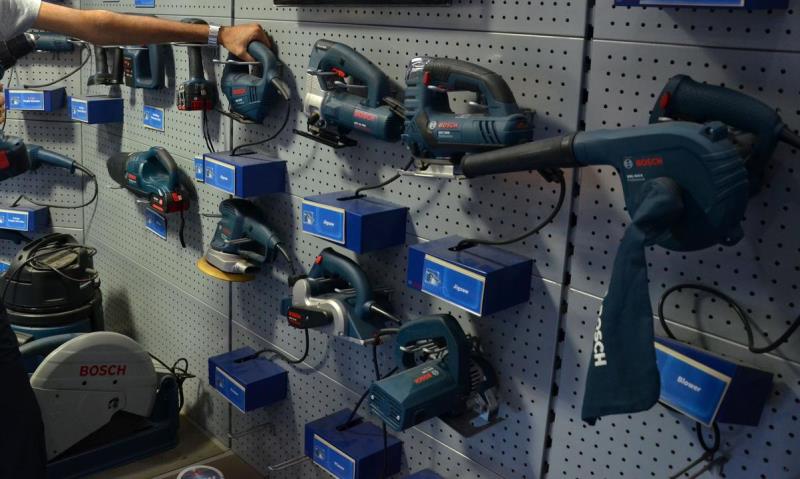
India is aiming to significantly expand its footprint in the global hand and power tools market, with a target of achieving $25 billion in exports over the next decade. According to a new report released by NITI Aayog on Tuesday, the country could potentially capture 10 percent of the global market in power tools and 25 percent in hand tools, generating approximately 35 lakh jobs in the process.
The report, titled “Unlocking $25+ Billion Export Potential – India’s Hand & Power Tools Sector,” lays out a detailed strategy to boost India’s competitiveness in this sector. Currently, the global trade in hand and power tools is valued at around $100 billion and is projected to grow to approximately $190 billion by 2035. Of this, hand tools are expected to expand from $34 billion to $60 billion, while power tools, including accessories, are set to grow from $63 billion to $134 billion.
China currently dominates the global export market, accounting for about half of the hand tools exports ($13 billion) and 40 percent of power tools exports ($22 billion). In contrast, India’s current exports stand at $600 million in hand tools and $470 million in power tools, translating to a modest market share of 1.8 percent and 0.7 percent respectively.
Despite its limited market share, the report suggests that India has the potential to significantly scale up its exports, targeting $25 billion over the next decade. Achieving this target could generate around 35 lakh jobs and help India capture 10 percent of the global power tools market and 25 percent of the hand tools market.
The report identifies a number of structural challenges that hinder India’s competitiveness, including a 14 to 17 percent cost disadvantage compared to China. These are attributed to higher raw material costs, lower labour productivity, elevated interest rates, and higher logistics costs, especially from inland production hubs to ports. Additionally, regulatory constraints such as restrictive overtime rules and complex export procedures further exacerbate these challenges.
To address these issues, the report recommends a set of strategic interventions. One major proposal is the development of world-class hand tool manufacturing clusters, spread over 4,000 acres and built under public-private partnerships. These clusters would offer modern infrastructure, including plug-and-play facilities, worker housing, and improved connectivity to support industrial growth.
It also calls for market reforms to reduce structural cost burdens. These include rationalizing import duties on critical raw materials, streamlining Quality Control Orders, simplifying the Export Promotion Capital Goods (EPCG) scheme, and revising labour and building regulations.
The report emphasizes that if these reforms are effectively implemented, no additional government support would be necessary beyond current schemes such as Remission of Duties and Taxes on Exported Products (RoDTEP) and duty drawbacks. However, in the absence of such reforms, it estimates a requirement of ₹8,000 crore in bridge cost support, which it frames as an investment likely to generate two to three times its value in tax revenues over five years.