
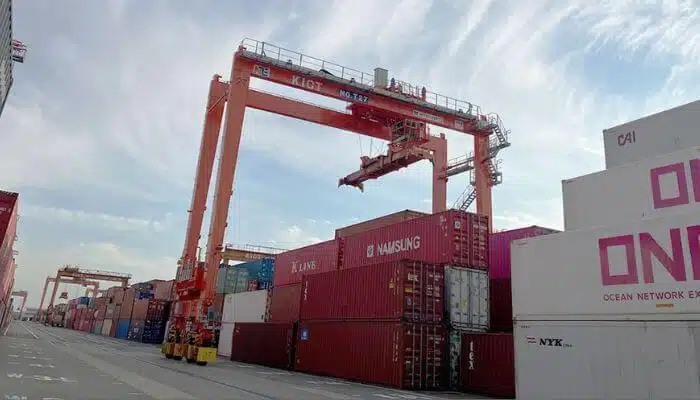
The Kobe-Osaka International Port Corporation of Japan is introducing an initiative to highlight the unparalleled operational prowess of its hydrogen-operated cargo handling machinery, highlighting a global first in transforming a rubber-tired gantry successfully (abbreviated RTG) diesel engine generator (of the crane) into a hydrogen engine version.
The Kinki Regional Development Bureau is commissioning the project associated with the Ministry of Land, Infrastructure, Transport, and Tourism with the Port and Harbor Bureau of the Kobe City Government. It will take place at the Kobe International Container Terminal (abbreviated the KICT), managed by Mitsui O.S.K. Lines (abbreviated the MOL), at the Port of Hanshin.
The assignment is part of a more extensive strategy that Japan pursues to make the ports carbon-neutral by undertaking the electrification of the cargo handling machinery and its conversion to hydrogen.
In line with the action plan, the Kobe-Osaka International Port will work with Shosen Koun Co., the owner of RTGs and KICT’s operator, to ensure a seamless and safe transition to hydrogen through on-site displays of decarbonized port activities.
Additionally, the maker of RTGs, Mitsui Engineering & Shipbuilding Co., the producer of hydrogen engines iLabo Co., Iwatani Corporation, which handles the supply, transportation, and fueling of hydrogen, and the consulting company Universal Energy Laboratory Corporation are involved in the endeavour.
During FY 2022-2023, the partners will focus on project planning to develop the implementation strategy for demonstration. Moving forward to the 2023 2024 fiscal year, the focus will shift toward the RTG crane conversion and trial operations, paving the way for field demonstration.
As the project unfolds into 2025, on-site verification will take place, primarily focusing on data acquisition and in-depth analysis. Subsequently, in the FY 2025 to 2026, the project is further poised for refinement via revising technical standards and establishing benchmarks in cargo handling machinery.