
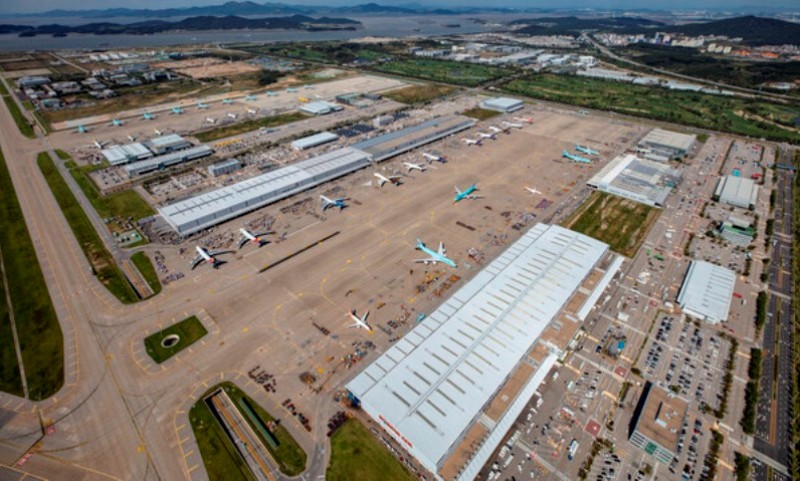
South Korea’s Incheon International Airport Corp (IIAC) expects air cargo to double, to 6m tonnes, this year, as manufacturers reorganise their supply chains and step up their “China plus One” strategy.
IIAC said on Thursday the airport, the main gateway to Seoul, had been growing as a link between China and the US, resulting in demand for warehousing seeing facilities surge from 1,000 sq metres a decade ago, to 20,000 sq metres now – thanks to the airport’s role as a global distribution centre for microchips and other strategic goods.
IIAC’s deputy GM (logistics sales), Lim Hoon, explained: “As part of ‘China plus One’, there is a demand for places to relocate cargo produced in China. The geographically feasible places are Taiwan, Hong Kong, Tokyo and Incheon.
“However, China-Taiwan relations have deteriorated and Hong Kong is politically close to China. While Tokyo is further from China, Incheon is closer and the free trade zone is in the hinterland, so it’s the most suitable location.”
Particularly, he added, transhipments through sea-and-air transport from China via IIA was increasing. Last year, such cargo grew 43% year on year, to 98,560 tonnes, and Chinese airports are the points of origin for all but one of IIA’s top transhipment routes, while eight out of the ten top destinations are US airports, such as Los Angeles and New York.
Mr Lim said: “In the second half of 2023, the increase in e-commerce cargo was the main reason for the increase in sea-and-air transport. This year, China Post has started flying cargo through Incheon and we expect sea-and-air volumes to increase again.”
He acknowledged there were doubts about whether China’s e-commerce export sales could really drive up air cargo volumes, particularly as the US Customs & Border Protection Agency had been intensifying inspections on imports to check for duty evasion. Reportedly, this has caused Chinese e-tailers to refrain from chartering flights to the US.
Mr Lim said: “According to local research, there is no full-scale inspection, but there are differences by region. Cities like Los Angeles and Dallas have stepped up their inspection rates for e-commerce and we’re seeing some backlogs.
“However, it’s difficult to completely halt the flow of Chinese goods into the US, as its consumers are familiar with Chinese e-commerce sites and goods. Furthermore, security issues and dangerous goods are filtered-out at Incheon, so it’s safer than being exported directly from China.”