
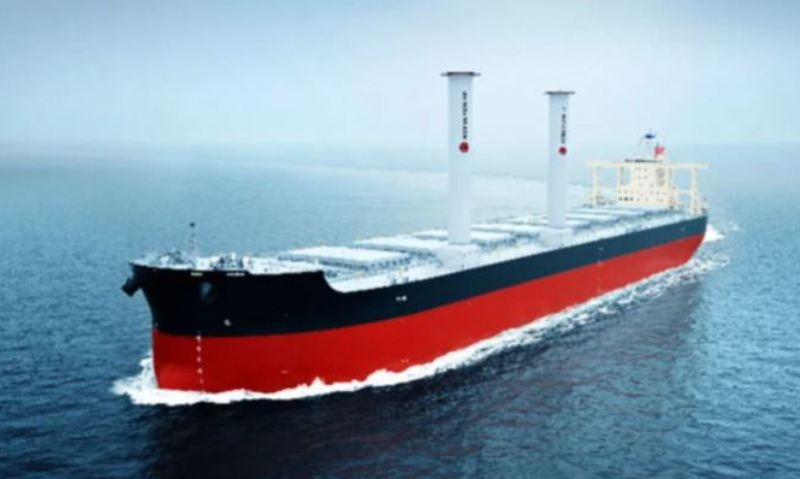
Mitsui O.S.K. Lines, Ltd. (MOL) and Vale International SA have announced the successful retrofit of a 200,000-ton class bulk carrier with two Norsepower Rotor Sails™. This marks the world’s first installation of rotor sails on a capesize bulk carrier.
The vessel, the Camellia Dream, is currently under contract for iron ore transportation for Vale and recently made its inaugural call at Ponta da Madeira, Brazil. The vessel has been retrofitted with two 35m x 5m Norsepower Rotor Sails. The retrofit is expected to yield significant environmental benefits, with projections indicating a 6-10% reduction in fuel consumption and greenhouse gas (GHG) emissions on routes between Brazil and the Far East.
Norsepower Rotor Sails are a modernized version of the Flettner rotor that uses the magnus effect to generate forward thrust, reducing overall fuel consumption and associated greenhouse gas emissions. The technology has been used across multiple sectors of the shipping industry for nearly a decade and has 300,000 operating hours of verified performance data, revealing fuel consumption savings of anywhere from 5-25%.
MOL, a global leader in shipping with a fleet of over 800 vessels, has implemented the technology as part of its commitment to achieving net-zero GHG emissions by 2050, aligning with their “MOL Group Environmental Vision 2.2,” which emphasizes the adoption of clean energy and energy-saving technologies.
Vale has set its own ambitious target of reducing scope 3 emissions by 15% by 2035. The company’s Ecoshipping program, a research and development initiative, has been instrumental in driving such innovations in partnership with shipowners.