
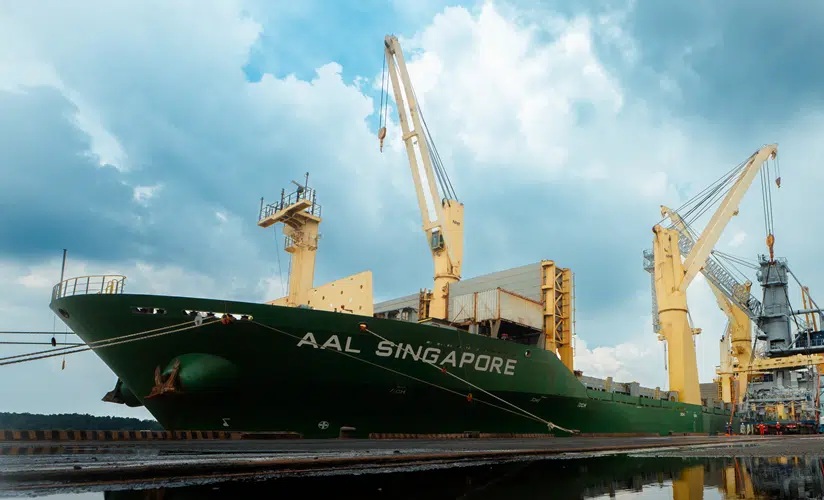
Project heavy-lift carrier AAL Shipping (AAL) has strengthened its footprint in Asia’s fast-growing Intra-Asia trade corridor with the successful transport and discharge of a 28-metre-high, 255-tonne shiploader aboard the ‘AAL Singapore’ on its Asia–Europe trade lane.
The oversized cargo was carried on one of AAL’s 31,000 dwt A-Class vessels, AAL Singapore, and safely discharged at the facilities of Foremost Milling Corporation in Bataan, Philippines. The unit will ultimately operate at the Mariveles Grain Corporation terminal, where it will form a vital component of the grain handling system.
Given the cargo’s extreme dimensions and handling requirements, the operation demanded precise engineering execution. A tandem lift was carried out using the vessel’s port-mounted 700-tonne maximum combi-lift cranes, stabilised by two counterweights, bringing the total gross lift to 312 tonnes.
Nicola Pacifico, Global Head of Engineering at AAL Shipping, highlighted the complexity of the lift. “The shiploader presented several engineering challenges, particularly during the lifting phase. To mitigate structural risks, a vertical lift from the pad eyes was essential, while also managing strict height and clearance constraints due to nearby structures including a generator and access platform,” he said.
The newly delivered shiploader boasts a discharge capacity of 10,000 tonnes per day, supporting grain import logistics and contributing to the Philippines’ local food industry growth.
Intra-Asia Trade Momentum Accelerates
The project underscores the rapid expansion of the Intra-Asia trade corridor, now the world’s fastest-growing regional trade segment. Intra-regional trade has increased by 43% over the past four decades and now accounts for more than half of Asia’s total trade.
Southeast Asia is at the forefront of this transformation, transitioning from labour-intensive industries to advanced manufacturing sectors such as electronics, semiconductors and automotive production. The shift has been further driven by the ‘China Plus One’ strategy, as global manufacturers diversify supply chains across multiple Asian markets to enhance resilience.
Manufacturing growth across the Association of Southeast Asian Nations (ASEAN) has remained steady since 2016, with intra-ASEAN trade rebounding 7% in 2024 to reach nearly US$3.56 trillion in combined imports and exports.
Rising Infrastructure Investments Drive Heavy-Lift Demand
Across Southeast Asia, more than US$110 billion worth of port infrastructure projects are currently underway, reflecting booming trade and industrial activity. Globally, port spending is projected to reach US$207 billion by 2030.
As port expansions scale up and project cargo grows in size and complexity, demand for specialised heavy-lift and multipurpose tonnage continues to rise.
Andrew Mangan, Chartering Manager at AAL Australia, emphasised the company’s capability to support this trend. “Our fleet is among the most capable in the industry in terms of lifting capacity, stowage flexibility and self-sufficiency. AAL operates regular monthly services across Asia’s major trade lanes, enabling customers to utilise scheduled long-haul services for Intra-Asia project cargo shipments,” he said.
He added that as regional manufacturing diversifies and ports expand to handle larger, more complex components, AAL remains well positioned to deliver EPC-grade engineering expertise, operational reliability and end-to-end accountability for major industrial projects.