
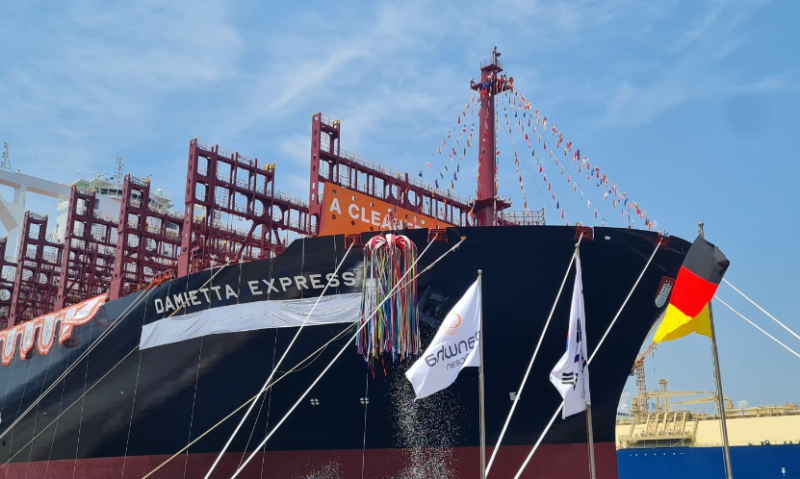
German shipping heavyweight Hapag-Lloyd has held a christening ceremony for its new liquefied natural gas (LNG) dual-fuel 23,600 TEU containership Damietta Express.
As informed, the ceremony took place at Hanwha Ocean’s shipyard in South Korea on May 24, 2024. The 400-meter long vessel is the fifth ship to join the company’s Hamburg Express-class series.
“With her advanced and efficient dual-fuel engines, her energy-efficient design and her many innovative features, the “Damietta Express” has been carefully crafted to meet today’s demands and to help us on our way forward into a challenging future,” Chief Financial Officer (CFO) of Hapag-Lloyd Mark Frese commented.
The first boxship in this class, Berlin Express, was named in October last year.
The new class of ships will make an important contribution to Hapag-Lloyd’s efforts to operate its entire fleet in a climate-neutral manner by 2045, according to the shipowner. Thanks to their new dual-fuel technology, they will also be able to operate using non-fossil fuels, such as bio-methane and e-methane, and thereby generate hardly any CO2 emissions.
For the time being, liquefied natural gas will be used, which should reduce CO2 emissions by up to 25% and soot emissions by 95%. In addition, advanced components, such as an optimized hull and a highly efficient propeller, will help the vessels to reduce fuel consumption and thereby greenhouse gas emissions.