
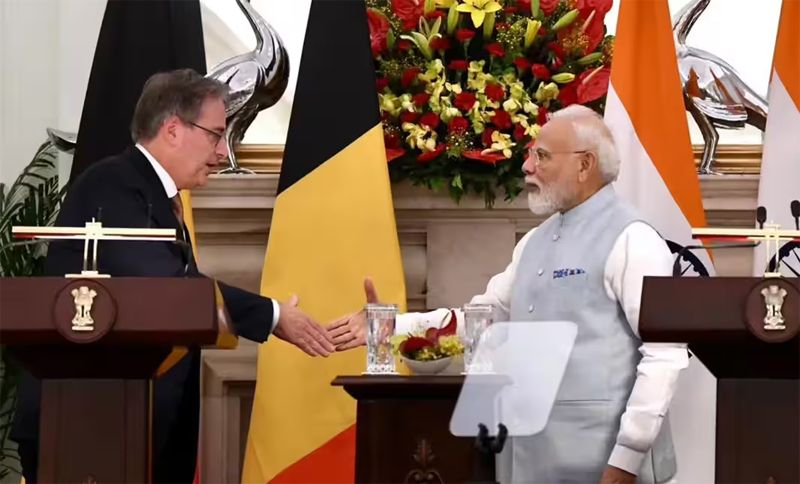
India and Belgium have agreed to significantly expand bilateral cooperation in defence, trade, investment, critical minerals, semiconductors, clean energy and maritime sectors, with Prime Minister Narendra Modi and Belgian Prime Minister Bart De Wever seeking to build a broader strategic partnership amid growing global geopolitical uncertainties.
The two leaders held wide-ranging discussions and agreed to double bilateral trade over the next five years. India-Belgium trade currently stands at around USD 13 billion, with bilateral trade reaching USD 13.01 billion in 2025-26.
Five agreements were signed during the visit, including pacts covering defence cooperation and renewable energy. An Investment Fast-Track Mechanism will also be established to facilitate and promote Belgian investments in India.
Defence emerged as a key pillar of the renewed partnership. In addition to the government-level defence agreement, 10 agreements involving Indian and Belgian defence companies were concluded on the sidelines of the leaders’ meeting. The agreements are expected to open opportunities for joint development and production of military equipment in India using Belgian technology, including rocket systems.
India has also decided to appoint a resident defence attaché at its embassy in Brussels, reflecting the growing strategic dimension of bilateral defence ties.
“Today, we agreed to enhance military exchanges and training cooperation between the two countries. The agreements between our governments and defence industries will open up new opportunities for defence co-development and co-production,” Modi said.
The two sides also agreed to strengthen intelligence sharing and cooperation between their agencies in combating transnational crime and terrorism. A separate MoU between India’s Central Bureau of Investigation (CBI) and the Belgian Federal Police will facilitate cooperation against transnational organised crime, cybercrime and related offences.
Trade and investment
Both leaders stressed the importance of expanding commercial ties and called for the timely implementation of the India-European Union Free Trade Agreement to unlock greater opportunities for trade and investment.
De Wever described the conclusion of the India-EU trade pact as a major milestone, saying Belgium wants to take its relationship with India to “another level — economically, politically, but also strategically.”
Belgium is already an important economic partner for India in Europe. The country’s role as a global diamond trading centre, particularly through Antwerp, makes diamond trade a significant component of bilateral commerce. Belgian FDI into India stood at approximately USD 4.2 billion between April 2000 and December 2025.
Focus on critical minerals, semiconductors and clean energy
The two countries identified critical minerals, high technologies, semiconductors and renewable energy as priority areas for future cooperation.
India and Belgium agreed to deepen collaboration in the processing and recycling of critical minerals. In semiconductors, Modi said Belgian technological expertise and India’s manufacturing scale could complement each other.
An MoU on renewable energy is expected to provide fresh momentum to cooperation in clean energy and sustainability.
Belgian company John Cockerill is already developing an electrolyser manufacturing facility in Kakinada, Andhra Pradesh, with an expected capacity of 2 GW, highlighting the potential for further Belgian investment in India’s clean-energy ecosystem.
Maritime and logistics cooperation
The two countries also see significant potential for cooperation in the maritime and logistics sectors.
Belgium’s position as a major European maritime and logistics hub, centred around its ports and extensive hinterland connectivity, offers opportunities for collaboration with India’s expanding port, shipping and multimodal logistics ecosystem.
Modi said the two countries had agreed to strengthen capacity building in the maritime sector, alongside expanding links between start-ups, universities and research institutions.
With both countries seeking more resilient and reliable supply chains, cooperation between Indian and Belgian ports, logistics companies, technology providers and maritime institutions could become an important component of the emerging partnership.
Geopolitical cooperation
The two prime ministers also discussed the conflicts in Ukraine and West Asia, calling for their resolution through dialogue and diplomacy in accordance with the UN Charter and international law.
India and Belgium reiterated their commitment to combating terrorism in all its forms.
Belgium also reaffirmed its support for India’s candidature for permanent membership of a reformed and expanded UN Security Council.
In the defence context, Belgium is understood to have conveyed that it will not supply critical military hardware to Pakistan.
New strategic dialogue
The latest agreements build on the establishment of a ministerial-level India-Belgium strategic dialogue in July. The inaugural dialogue was held in Brussels on July 15 and was co-chaired by External Affairs Minister S. Jaishankar and Belgian Deputy Prime Minister Maxime Prevot.
The new institutional mechanism is expected to provide a structured platform for advancing bilateral economic, technological, security and strategic cooperation.
India and Belgium have maintained diplomatic relations since September 1947 and share more than three centuries of historical ties. The Belgian Economic Mission led by Princess Astrid to India in March last year resulted in around 40 agreements, providing further momentum to bilateral commercial engagement.
With defence, trade, investment, clean energy, critical minerals, technology and maritime connectivity now emerging as key areas, the latest India-Belgium engagement signals an effort by both countries to build a deeper and more strategically diversified partnership.