
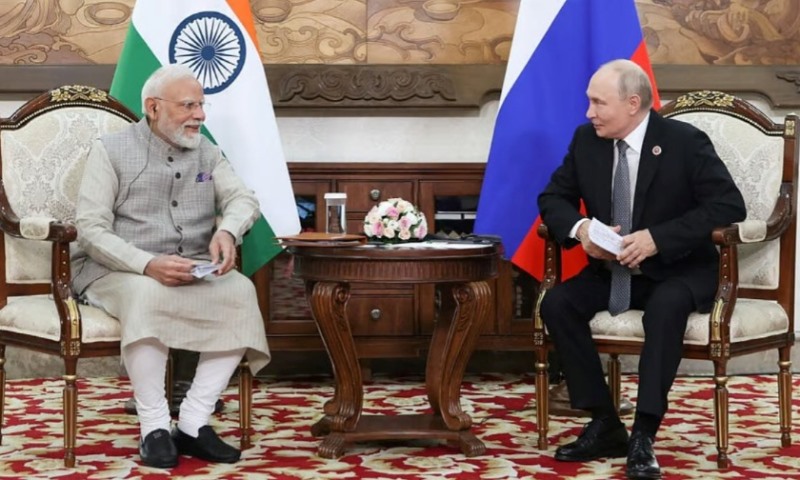
Prime Minister Narendra Modi has urged Russian President Vladimir Putin to move away from the “endless war” in Ukraine towards an early end to the conflict, while assuring Iranian President Massoud Pezeshkian that India will continue supporting diplomatic efforts to restore peace in West Asia.
Modi delivered the message during separate meetings with Putin and Pezeshkian on the sidelines of the Shanghai Cooperation Organisation (SCO) summit in Bishkek, capital of Kyrgyzstan. The two meetings came less than a fortnight before Modi is scheduled to host both leaders at the BRICS summit in New Delhi.
During his meeting with Putin, Modi reiterated India’s consistent call for an early and peaceful resolution of the Russia-Ukraine conflict.
“India supports all efforts towards peace and will continue to do so. Every day spent in war sets humanity back, whereas every step taken towards peace fills humanity with new hope and enthusiasm,” Modi said.
“We must move away from endless war towards an end to the war. This is essential for the well-being of humanity. A peaceful resolution to all issues at the earliest is the call of humanity,” he added, invoking India’s long-standing message of peace associated with Gautama Buddha and Mahatma Gandhi.
Putin responded by thanking Modi and said Russia was moving in that direction.
The Russia-Ukraine conflict has entered its fifth year, with Moscow continuing drone and missile attacks against Ukrainian cities and infrastructure, while Kyiv has expanded long-range strikes against targets inside Russia. Diplomatic efforts have continued intermittently, but differences over territory, security guarantees and the terms of a political settlement remain unresolved.
For India, the prolonged conflict has implications for energy and commodity prices, trade and supply chains, inflation, and food and fertiliser security. The war has also contributed to wider geopolitical uncertainty and heightened vulnerabilities for developing economies.
India stresses safety of commercial shipping in West Asia
In his meeting with Iranian President Massoud Pezeshkian, Modi discussed bilateral relations as well as the latest developments in the West Asia conflict involving Iran, Israel and the United States.
Modi expressed concern over the escalation of tensions and reiterated India’s position that all outstanding issues must be resolved through dialogue and diplomacy. He stressed the need for sustained efforts to achieve lasting peace and stability in the region.
A key focus of the discussions was maritime security. Modi called for safeguarding the freedom of navigation and commerce and emphasised that civilians and civilian infrastructure, including commercial vessels and seafarers, must not be targeted under any circumstances.
The issue assumes particular significance for India amid heightened tensions around the Strait of Hormuz, a critical maritime chokepoint for global energy supplies and international trade. Disruptions in and around the waterway have raised concerns for India’s energy security, trade flows and maritime connectivity.
Modi also conveyed India’s concerns over attacks on commercial shipping and the safety of Indian seafarers to Pezeshkian.
According to Iran’s diplomatic mission in New Delhi, Pezeshkian highlighted the deep historical and cultural ties between India and Iran and urged Modi to use India’s extensive diplomatic contacts with various parties to help move the region away from war and bloodshed towards dialogue and agreement.
The Iranian president expressed appreciation for India’s support and cooperation during the recent conflict and called for intensified diplomatic efforts to establish peace and security in the region. He said Iran had sought to resolve issues through dialogue and negotiations and maintained that continued war served neither Iran, the region nor humanity.
Following the meeting, Modi posted on X that India would continue to support all efforts aimed at securing lasting peace in the region.
The two leaders also discussed bilateral cooperation, including transportation and maritime affairs, developments concerning the Strait of Hormuz and progress on cooperation at Chabahar Port.
Modi reiterated India’s readiness to work closely with Iran through multilateral platforms, including BRICS and the SCO.
The discussions underline India’s broader diplomatic approach of advocating dialogue, de-escalation and freedom of navigation while protecting its strategic interests, energy security and the safety of its seafarers and commercial shipping.