
India is preparing a new incentive scheme to promote domestic manufacturing of shipbuilding components and parts, as the government accelerates efforts to transform the country into one of the world’s top five shipbuilding nations by 2047.
The Ministry of Ports, Shipping and Waterways has initiated discussions on the proposed scheme, which is expected to support the development of ancillary industries supplying critical shipbuilding components including engines, anchors, propellers, electrical systems, accommodation modules and maritime cranes.
The initiative comes alongside the government’s ongoing push to strengthen local manufacturing of cargo containers and maritime cranes, sectors currently dominated by China.
Officials said the proposed scheme for shipbuilding component manufacturing is likely to include capital expenditure (capex) subsidies and production-linked incentives (PLI) to encourage investments and build a robust domestic supply chain.
“Shipbuilding is such a massive industry, it requires hundreds of components where some government support is required. As India develops shipbuilding clusters, support is vital to develop the ancillary industries that will manufacture components and parts,” a government official said.
Manish Sharma, Partner and Leader (Infrastructure, Transport & Logistics) at PwC India
, said shipbuilding is heavily dependent on ancillary industries and highlighted the importance of integrated manufacturing ecosystems.
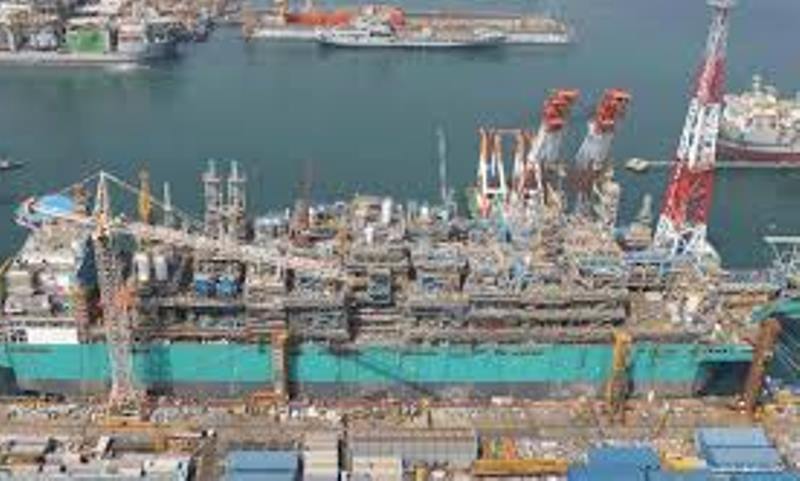
Citing South Korea’s Busan shipbuilding ecosystem as an example, Sharma noted that suppliers of engines, steel, paint, propellers and accommodation systems operate close to shipyards, enabling just-in-time manufacturing and reducing inventory costs.
The proposed scheme aligns with plans by HD Hyundai
subsidiary HD Korea Shipbuilding & Offshore Engineering (HD KSOE) to establish a USD 4 billion greenfield shipyard at Thoothukudi in Tamil Nadu with an annual capacity of 3.5–4 million gross tonnage (GT).
The Thoothukudi shipbuilding cluster, spread across around 3,000 acres, is expected to accommodate shipbuilding vendors and ancillary industries alongside the anchor shipyard.
HD Hyundai is also exploring plans to establish a maritime crane manufacturing unit within the cluster. In December 2025, the South Korean shipbuilder signed an MoU with BEML Ltd
to collaborate on maritime crane manufacturing.
In September 2025, the Union Cabinet approved a ₹69,725 crore package to strengthen India’s shipbuilding sector.
The package includes ₹24,736 crore under the Shipbuilding Financial Assistance Scheme (SBFAS), ₹25,000 crore under the Maritime Development Fund (MDF), and ₹19,989 crore under the Shipbuilding Development Scheme (SbDS).
The SBFAS aims to bridge the cost gap faced by Indian shipyards compared to foreign competitors and incentivise shipbuilding and ship recycling activities.
The Maritime Development Fund will provide long-term financing support for the maritime sector through a blended finance model involving both government and private investment.
Meanwhile, the Shipbuilding Development Scheme seeks to expand shipyard capacity, enhance R&D, strengthen ship design capabilities, develop skilled manpower and create common infrastructure in line with the Maritime India Vision 2030 and Maritime Amrit Kaal Vision 2047 targets.
Indian entities are currently planning to build around 437 ships across various categories, with a combined gross tonnage of 19 million GT and investments estimated at ₹2.2 lakh crore. Of these, 62 vessels are expected to be ordered within the next 12 months.
(source: ET Infra)