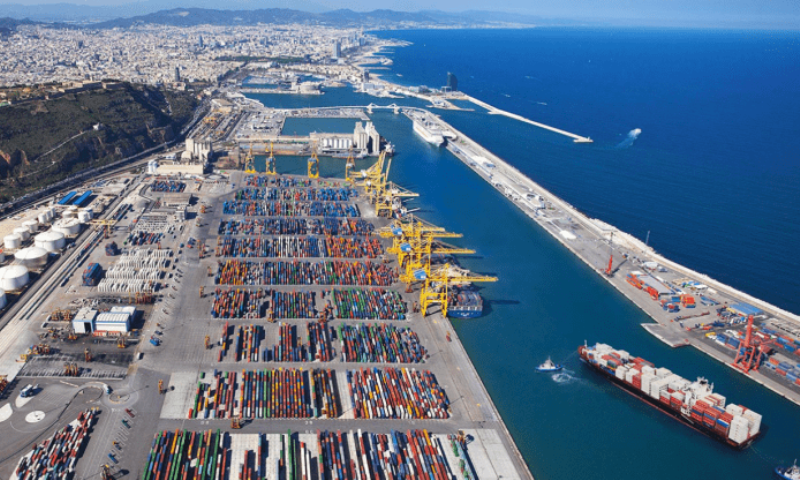
The Territorial Commission of Catalonia has approved the Intermodal Logistics Terminal of the Port of Barcelona Urban Master Plan (PDU), a document that organises the development of the railway infrastructure in the south area of the port.
This railway node comprises a group of infrastructures, including: a rolling road terminal, a reception and dispatch terminal, and a loading and unloading terminal, all located on the former bed of the Llobregat River, as well as a reception and dispatch terminal parallel to the current course of the river and known as Terminal Nou Llobregat.
This is a supramunicipal infrastructure, developed thanks to the port reaching a consensus with the city councils of Barcelona and El Prat, and also involving the Government of Catalonia and Barcelona Regional.
In practice, the approval of the PDU green-lights the construction of the Port of Barcelona south railway node, which will facilitate the transfer of large volumes of goods from road to rail and will substantially cut the emissions produced by logistics chains and other negative externalities, such as road congestion and accidents.
Building this railway junction will require an investment of approximately €265 million ($307.86 million).
Of this amount, €70 million ($81.3 million) corresponds to the Nou Llobregat Terminal, located parallel to the new Llobregat riverbed and already under construction, while €150 million ($174 million) corresponds to the future terminals of the old riverbed and €45 million ($52.3 million) will be earmarked for complementary works that will provide service to the entire infrastructure.
In compliance with the PDU, the Port of Barcelona will invest €26 million ($30.2 million) to create green areas.
The approval granted on 1 December by the Territorial Commission of Catalonia marks the end of a lengthy dialogue and negotiation process involving four years of procedures, including a citizens participatory process, environmental formalities and public information, and means the necessary actions to build the railway node can now commence.
The Port of Barcelona is fostering rail transport because it is both efficient and competitive. This port strategy has removed the need for more than 1.7 million truck journeys over the last 10 years.
In 2024, rail traffic in the port area totalled 11,000 movements, meaning the removal of 155,000 trucks from the road transport mode. Replacing this road traffic avoided 48,500 tonnes of CO2 emissions, equivalent to planting 291,000 trees.
Earlier this summer, the Port of Barcelona Management Board approved four significant agreements aimed at enhancing port competitiveness, logistics development, sustainability, and the modernisation of facilities.
