
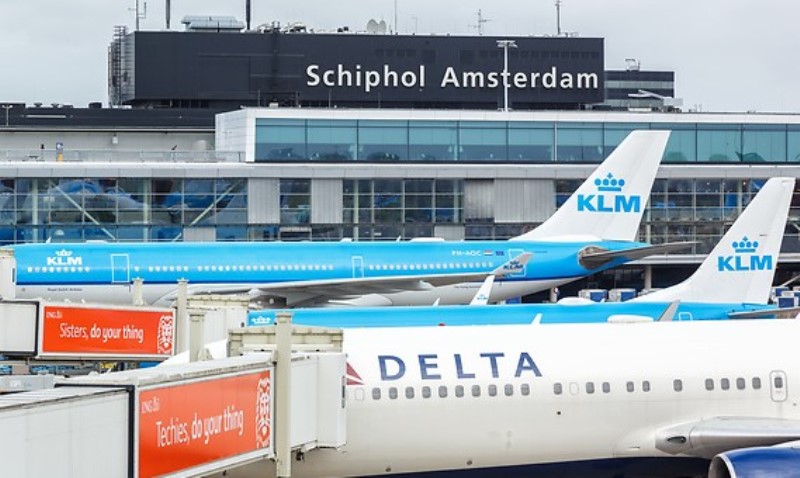
Freight will be disproportionately impacted by Schiphol Airport’s proposed new tariffs – a 41% hike from 1 April – the Netherlands Authority for Consumers and Markets (ACM) heard on Friday.
The proposed tariff hikes, under consideration by the ACM after complaints, are substantial: an average of 37% over three years. And 2026 will see a further 7.3% rise, and then 12.5% from April 2027.
Royal Schiphol Group has argued that it needs the money for “continued and necessary investments in our airport infrastructure and process efficiencies”.
CFO Robert Carsouw said it was “not only to get the main activity of aviation out of the red, but also to be able to realise our ambitious investment plans. And then we still have to borrow more.”
The airport also noted, in its 2024 financial results published on Friday: “For Schiphol, the airport charges are also an important instrument in reducing noise disturbance for the local community.
“Schiphol’s airport charges consist of fixed rates per passenger plus a charge linked to the type of aircraft. Schiphol has made this distinction in its charges for some time now, but will be tightening it considerably over the next three years to bring it more in line with the aircraft’s impact on the surrounding area.”
Night flights will become three to six times more expensive than day flights, depending on the aircraft.
But this discriminates against cargo operations, argued Air Cargo Netherlands (ACN) at the ACM meeting adding: “The tariff increase for cargo aircraft is disproportionate.
“Schiphol must be quieter and cleaner. The air cargo industry also agrees on this. Tariff differentiation according to the idea of ‘the polluter pays’ can be a means to this end.
“However, the differentiation that Schiphol has now implemented – at least for the cargo aircraft segment (so-called ‘full freighters’) – overshoots this goal and leads to a disproportionate tariff increase for cargo aircraft. This is contrary to the principles of the Aviation Act.”
ACN pointed out that more than half of the airport’s cargo was moved by freighters, some 7,500 annually, using 15,000 slots – some 3% of the total.
“These are not the newest aircraft and, moreover, cargo planes are more heavily loaded than passenger aircraft and they fly relatively more at night.
“Many airlines have ordered new, cleaner, and quieter cargo planes, but due to global problems in supply chains, the majority of these aircraft will not be delivered until 2027.
“Our objection is that there are no alternatives for this mode of transport in the short term. The loss of cargo planes will affect Schiphol’s network quality.”
It added: “Cargo flights are relatively footloose. They can relatively easily divert to the surrounding airports and a large proportion will do so.”
It pointed to a study by SEO Economic Research, which showed that an increase of about €1,500 would lead to a 25% reduction in cargo flights at Schiphol, and a 12% decrease in cargo volumes,
“This harms Schiphol’s function as an air cargo hub and therefore harms the airport’s network quality – also for passenger connections.”
ACN also argued that the decision to penalise some aircraft types effectively meant the airport “is taking the legislator’s seat”, against ICAO policies on airport charges.
“Section II, article 8(ii) of the ICAO states ‘Noise-related charges should be non-discriminatory between users and not be established at such levels to be prohibitively high for the operation of certain aircraft’.”
ACN added: “If the high tariffs are implemented, some of the freighters will be diverted to other airports. This will also put pressure on Schiphol’s network function for passenger aircraft.”
However, Schiphol countered: “The proposed tariff increase is the result of exceptionally high inflation, sharply increased interest rates during the past three years, and increased focus on the qualities. In accordance with the Aviation Act, they also include compensation for lost revenues from the Covid-19 period. To limit the increase in airport charges for airlines, Schiphol is voluntarily contributing €100m”.
In the 2024 results, Schiphol saw revenues grow 21%, to €2.24bn, with a net result of €418m, up from €22m the previous year. The number of full freighter flights was down 1.9%, although volumes rose 8.2%, to 1.49m tonnes.
The ACM has yet to announce its decision.