
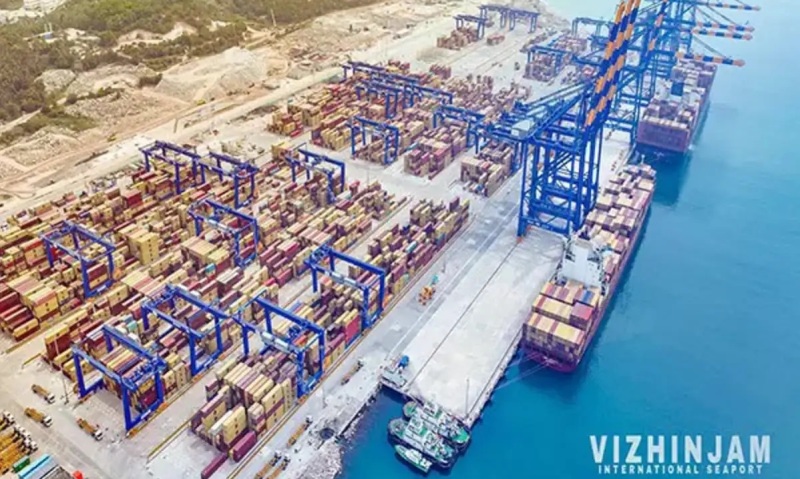
The Vizhinjam International Transshipment Deepwater Multipurpose Seaport is an ambitious project that has been taken up by the State Government of Kerala in India and Adani Ports and Logistics. Located in Vizhinjam, Kerala, APSEZ is developing the deep-sea water port as India’s first ‘mega transshipment container terminal’.
Vizhinjam International Seaport is a world-class, future-ready port and the only transshipment hub in the Indian subcontinent. It is the closest to the international shipping routes, and is centrally located on the Indian coastline. This port boasts a natural draft of 20 – 24m and minimal littoral drift. Vizhinjam ushered in a new era in India’s maritime history with the arrival of the first ship, Maersk’s San Fernando – a 300-metre-long container vessel, at the port in July 2024.
It debuted as India’s automated port with state-of-the-art infrastructure, facilities, capable of handling large ships, with its modern container handling equipment and world-class automation and IT systems.
Almost 35 to 40 percent of the cargo that is consumed globally is generated by China. No doubts about it. So what it means is that all the larger vessels, larger seagoing vessels, now except for crude oil, except for oil. Okay, oil, as you know, emerges mostly, you know, almost 50 percent of it emerges from the oil. All the large container vessels that are flying on the high seas across the globe, many of them originate from the Chinese ports like Shanghai or Hong Kong or, you know, they have so many ports on the South China Sea.
China Has a Major Portion of Market Share
These Chinese, these sea-going, container vessels which originate from the Chinese ports, if they are sailing across to the west coast of the U.S., they sail right across the Pacific Ocean to the U.S. west coast. You have Long Beach, you have Los Angeles, you have Oakland, all those ports on the west coast of the U.S. Now, if they are sailing to Africa, if they are sailing to Southeast Asia, if they are sailing to, their destination is South Asia or Europe or the east coast of the U.S., they moved down the South China Sea towards Singapore, which is typically the first port of call after leaving the Chinese coast. Then from Singapore, it comes into the Malacca Strait, which is a narrow strip of sea between Indonesia and Malaysia.
From there on, it enters the Bay of Bengal, cuts across the Bay of Bengal, you know, goes around India’s south coast, it goes around Sri Lanka. And typically, you have a large deepwater seaport in Colombo. Yeah. So after Singapore, the next port of call is quite often Colombo.
Then from there on, it comes along the south coast of India, right down to Trivandrum, the capital city of a small state called Kerala. And it turns west, cutting across the Arabian Sea towards the Red Sea. This route is the world’s busiest sea route. These large mother vessels don’t normally touch any of the Indian ports because India is a small player in global trade, unlike China, which has a market share of about two-thirds of the world’s traffic. India is a big player, which has about two percent of global trade.
Indian Ports
As such, Indian ports by themselves do not generate large volumes of containers like China does. Indian ports have emerged over have emerged over the past two, three centuries, right from the time the British were ruling India. And those times, the technology was very primitive and the ports have come up either on river mouths or on bays or on very calm waters, which are natural harbors.
And the advantage of a natural harbor is easily build a boat there, but the disadvantage is that you don’t get the deep draft required by the large sea-going vessels that are currently flying. So Indian boats suffer from two reasons. First is, insufficient cargo to attract the large sea liners, shipping lines, and the second is the inadequacy of the draft. They can’t berth here. What happens to the limited engine cargo that goes to other countries. We typically send the cargoes in small vessels called feeder ships which go down to East Coast of India, sometimes to Singapore or to one of those Malaysian ports, averting Singapore on the Malacca Strait or to Colombo or maybe to Dubai or Salalah. So in the neighboring countries where these large shipping lines come, Indian cargo gets dropped there and they get transhipped.
Public-Private Partnership
Vizhinjam International Seaport is being operated by India. The port is owned by the government of Kerala, the state government, and is operated by India’s largest port operator – Adani Ports and SEZ Limited – a public-private partnership. Our private partner Adani has got the global reach to practically all the large shipping lines across the world and in the initial phase, it is 100 percent occupied, all the boats are occupied by MSC vessels, both mother ships, as well as these feeders.
Cruising is something that could probably happen over time. Already in Kochin, which is about 200 kilometers north of Trivandrum, we do have a well-established cruise terminal where almost 40 to 50 vessels call, cruise ships call every…
2025 – Record Year for the Port
2025 has been a record year in terms of global trade. India had achieved significant milestones naturally, this grows, but it’s been a sort of chicken or egg situation, where you have a very inefficient logistics system. We are probably the third-largest, already the fourth-largest economy in the world, and aiming to become the third-largest in the next three, four years’ time. So, India’s share in the global market is indeed growing robustly. India is the only economy that is showing 6 percent plus growth.
With that long-term vision, the Government of India is also stepping up, addressing all the gaps in infrastructure facilities in terms of connectivity and infrastructure In comparison to the European ports, where they’re only going for green ports, and adoption of artificial intelligence. By global standards, we are very small in size. We are just about 2 percent the size of Shanghai, which is the world’s largest container terminal.
We are just 2 percent. So maybe three years or four years down the line, we will reach about 8 percent capacity. But by Indian standards, that’s significant. So here, though we are small in size, our technology adoption, our equipment used are all state-of-the-art, cutting-edge technology, at par with Shanghai. Even your European ports are one step behind Shanghai. The world’s most tech-savvy port is Shanghai. The new William Port in India is at par with Shanghai, probably slightly ahead of Singapore or Abu Dhabi, which are next in line.
European ports are still way behind. One generation behind, I would say. So that is in terms of technology adoption. Vizhinjam International Seaport is almost 100 percent automated port except for the lifting of the container from the vessel, where some human intervention is required. Otherwise, it’s 100 percent automated.
Decarbonization
The port operator Adani has set certain targets. Now, the bigger thing is in terms of the bunkering fuels used by the vessels. They are rapidly shifting towards LNG, which is a cleaner fuel. But green hydrogen and all would probably take more time. So, right now, the port has become operational. We have not yet started bunkering.
That would commence in the next two or three years because it’s a stage-wise adoption of all the port-related maritime services, logistic services. Currently, what’s happening is just transshipment. Vessels come and drop cargo. Some vessels from some corner of the world come and drop boxes here. Some other vessels from some other corner of the world come and pick up boxes. So it continues.
All the boxes remain within a custom-bonded area within the port itself. We have to now open our gates for exit cargo movement. That’s from the land side, cargo comes in. Similarly, imported cargo goes out on the land side. This port has come up in a location that does not have a maritime DNA. When I say maritime DNA, look at Bombay, Kolkata, and Chennai. All these are port cities that have evolved over the last two or three centuries. These ports have evolved over many centuries when the British ruled India. So, naturally, there is a support system. There is an industrial and maritime ecosystem around those ports, which has evolved over the centuries.
India’s Gateway
Now, the William Port is a brand new state-of-the-art port, which has all of a sudden, as if God has dropped it into our laps, the most modern port has come up. But when we look at the other infrastructure complementing it, we are lacking, but we are addressing all that. The government is also taking policy initiatives to address those gaps and complete all that in a time-bound manner.
Ports will have a very significant role in this part of the world. And make a very significant contribution to India’s global trade. It’ll be a game changer. I keep repeating that, this is India’s gateway to the whole world. Imagine no other Indian port can claim the advantages that this port is enjoying.
We are connected to practically the whole world, all the continents.