
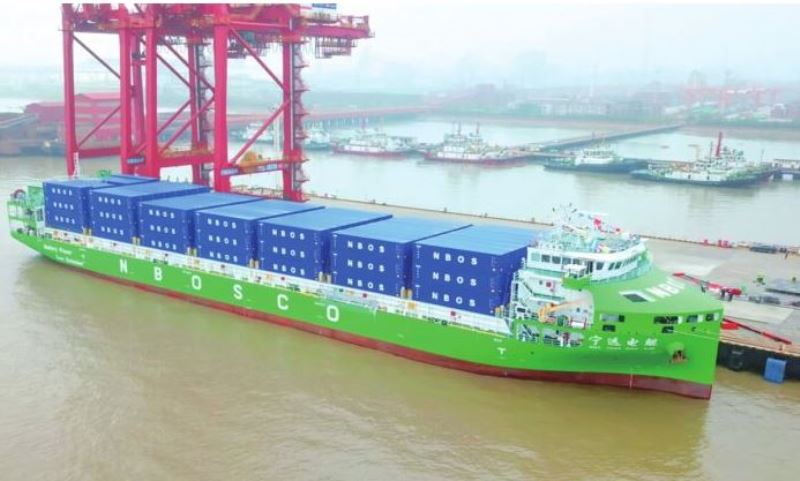
China has marked a major milestone in maritime decarbonisation with the delivery of the world’s largest all-electric container vessel, Ningyuan Diankun, now officially in commercial service. Developed by Ningbo Ocean Shipping Co., the 10,000-tonne vessel is China’s first fully electric intelligent container ship and the largest of its kind globally.
The vessel measures 127.8 metres in length and 21.6 metres in width, offering capacity for 742 TEU containers. It is powered by 10 battery containers with a combined storage capacity of around 20,000 kWh—roughly equal to the batteries of 300 electric cars.
Ningyuan Diankun has begun operations on the route between Ningbo-Zhoushan Port and Jiaxing Port in Zhejiang Province, replacing conventional fuel-powered coastal services with zero-emission transport. Operators estimate annual savings of 580 tonnes of fuel and more than 1,400 tonnes of CO₂ emissions.
The vessel also features advanced smart-navigation systems, including autonomous route planning, collision avoidance, real-time monitoring, and integrated ship-shore-cloud controls, highlighting China’s push to combine electrification with intelligent shipping technology.
Industry experts see the launch as a significant step toward cleaner short-sea shipping, though battery range limitations mean fully electric vessels remain best suited for coastal and regional routes for now.