
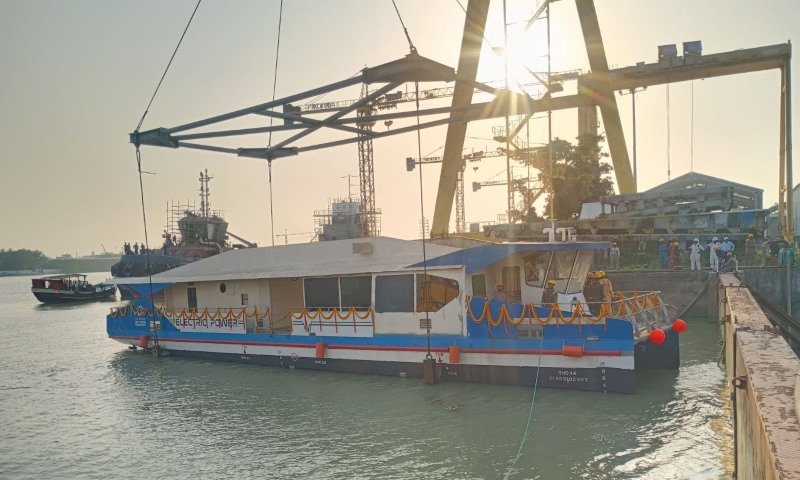
The fourth hybrid electric catamaran built for the Inland Waterways Authority of India (IWAI) was successfully launched on Tuesday, marking another milestone in India’s push toward sustainable river transport.
The vessel was ceremonially launched by Smt. Archana Singh, wife of IWAI Director Shri Kuldeep Singh, at the shipyard of Hooghly Cochin Shipyard Ltd (HooghlyCSL), a wholly owned subsidiary of Cochin Shipyard Limited.
This catamaran is part of a series of six vessels being constructed for IWAI to promote eco-friendly tourism and enhance inland waterway connectivity across the country.
Built under the classification of the Indian Register of Shipping, the vessel incorporates advanced lithium-titanate battery technology paired with an electric propulsion system. It is capable of operating in a fully electric, zero-emission mode, as well as a hybrid mode that ensures extended operational endurance.
The project reflects India’s growing emphasis on green maritime solutions and sustainable transport infrastructure, particularly in the inland waterways sector.
Officials noted that the deployment of such vessels is expected to significantly reduce carbon emissions while improving passenger experience and operational efficiency.