
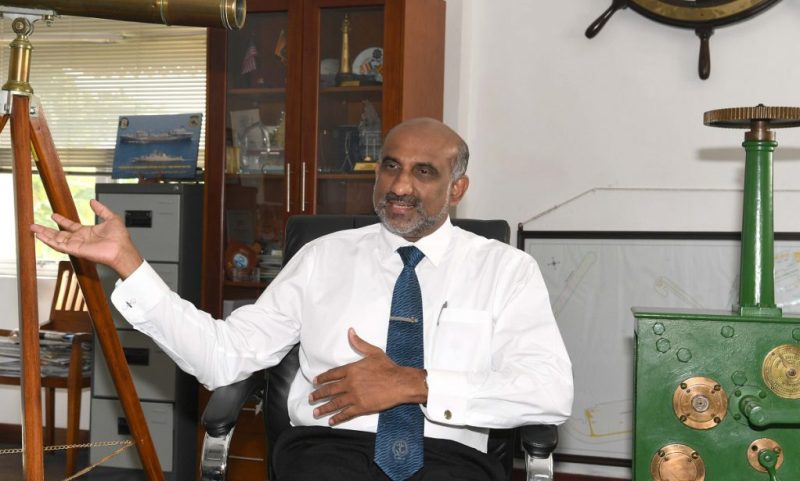
Sri Lanka Port Authority’s Harbour Master Capt. Nirmal Silva this week underscored the strategic importance of leveraging Sri Lanka’s geographical proximity to Indian economic powerhouse to drive growth in the port and marine industries.
Speaking at the media briefing on ‘Voyage Sri Lanka: Sailing to the Blue Economy’ held at the Export Development Board (EDB), he emphasised that the National Ports Master Plan (NPMP) is poised to position Sri Lanka as a key player in regional trade, logistics and services.
Capt. Silva highlighted the Colombo Port’s critical role as a transhipment hub for South Asia, particularly for Indian cargo. “Colombo is the busiest intermediate port for Indian trade thanks to its natural location advantage and competitive pricing,” he added.
He said at present about 84% of the total Twenty-Foot Equivalent Units (TEUs) handled at the Colombo Port are from transhipment operations and the port is expected to hit a record 7 million TEUs by the end of this month, nearing its total capacity of 8 million TEUs. In the first half of 2024, overall transhipment volumes grew by 6.1% YoY to 4.19 million TEUs driven by double-digit growth recorded during the first four months of the year.
With the East Container Terminal (ECT) slated for completion by mid-2026 and the Colombo West International Terminal (CWIT) — a collaboration between India’s Adani, John Keells Group and the Sri Lanka Ports Authority (SLPA) set to wrap up first phase by February 2025.
Capt. Silva expressed confidence that Colombo is gearing up for a significant capacity boost and dismissed speculations on Indian developments in their ports are a threat to Sri Lanka.
“We are also developing new container terminals to meet the projected new demands. The entire CWIT project is expected to be completed by Q3 2026, while plans for WCT-2 are already underway with Expressions of Interest (EoIs) invited for feasibility studies,” he added.
As Colombo remains central, the Harbour Master said the NPMP outlines ambitious plans for Trincomalee and Galle ports as well.
“Recognised as the world’s fifth largest natural harbour, Trincomallee is being developed as an industrial port with significant opportunities for green energy investments,” he explained.
Capt. Silva pointed to its vast capacity as a key draw for service-oriented businesses.
Galle port, he said, is envisioned as a tourism port with plans to build a passenger terminal and a yacht marina with associated facilities for tourist activities. “A total of seven bidders have already expressed interest with five qualifying for Request for Proposals (RFPs). Due to high demand, the deadline for submission has been extended by a month from 28 November,” he said.
The Harbour Master stressed that the ongoing developments in the ports and marine industries such as ship building, repairing, bunkering could be transformative for Sri Lanka, particularly as the region benefits from India’s economic boom.
“Sri Lanka’s location provides a unique opportunity to capitalise on regional growth and the Sri Lankan Ports could become a game-changer for modern, service-led development,” he opined.
Capt. Silva also noted the importance of ensuring seamless integration between the ports and emerging industries particularly on green energy and tourism to maximise economic gains.
He stressed the need for Sri Lanka to align itself with regional economic development with India and position its ports as competitive and reliable trade hubs.